Category: Transport Planning

Looking at Transport Planning and Design

Concerns on the Manukau South Link

Port of Auckland – Can we talk please?

Caught this today in the Manukau Courier. Rather interesting that they bring this up today of all days. Ah well lets take a look:

Wiri train tracks block access

Creating a southern connection between the Manukau Train Station and the main trunk line could be more difficult than first thought.

Local boards throughout the south have called for the link so passengers can travel from Manukau to Papakura and Pukekohe directly.

Passengers wanting to head south from Manukau now have to transfer at Papatoetoe.

But a Kiwirail spokeswoman says if the connection gets approval it would need to cross tracks that lead to Ports of Auckland’s inland port at Wiri.

That would require reconstruction of those tracks.

“This part of the rail corridor has quite complex track layouts because of the Manukau branch junction, the port facility and the EMU [Electric Multiple Units] depot,” she says.

A Ports of Auckland spokesman didn’t want to comment on how ripping up its tracks could affect operations at the port because no-one had put forward an official proposal to do the work.

But Manurewa Local Board chairwoman Angela Dalton says linking the Manukau station with the main trunk line made more sense than other transport projects being pushed.

“It doesn’t make sense to me, pouring money into the city rail link when we need to get things moving out here.

“We need to get cars off the streets and the trains connecting effectively.”

Auckland Transport‘s main priority at the Manukau line is double-tracking it so services can run every 10 minutes to and from Britomart, council documents show.

It’s also assessing the viability of a link between the two lines as part of its rail development plan.


The Manukau South (Rail) Link is a project that I have been following closely since I first raised the point that a Electrification Mast would be in the road of the south link early last year. It is a project that I still follow closely while Auckland Transport develop a case study for this link – that south so desperately need!

In saying that though has anyone actually approached Port of Auckland and had a decent conversation with them on how the South Link might work. Work as in POAL has their Wiri Inland Port that covers part of the South Link path. And whether POAL should move their Wiri facility 900 metres down the road where this is a mothballed siding and massive block of land sitting vacant.

Port of Auckland I think we of the South need to have a chat over coffee and hot scones. What do you think?


Belmont and the Prime Minister

Hmmm…


For once it is not Orsman doing a piece on the Unitary Plan in the Herald. Meaning I might get a 10% chance (rather than a -100% chance with Orsman (although his last three articles were actually quite good (although did he actually write them or take his meds prior))) of it being balanced (to a degree we allow the media in some sway here).

This article from the NZH today: “Belmont intensification ‘madness’” has three themes running today. The first theme is an embed of a NewstalkZB interview on the Unitary Plan with Leighton Smith and the Prime Minister. The second theme was on Belmont, the UP and a surprising admission. The third theme was one I call ‘From the Files of the Loon Bin.’ The Loon Bin theme was also addressed by the Prime Minister in his ZB interview as well.

The First Theme

The Prime Minister was questioned on aspects of the Unitary Plan by Leighton Smith. The interview trundled along well enough looking at aspects of the Unitary Plan. Points made by the Prime Minister were:

  • Recognise Brownfield and Greenfield urban development will happen
  • People will choose to live in apartments
  • Three year formal notification period
  • We are not China thus will not cap growth (ties into the third theme)
  • Auckland essentially has critical mass behind thus will attract growth – something I mentioned here: “Growing Up
  • Been concerns from the leafy suburbs of Auckland (North and Isthmus) – but Leighton Smith did point out correctly Papakura from the South with us facing down 18 Storeys being a Metropolitan Centre under the UP.

Just a note from the above: WILL PEOPLE STOP FORGETTING SOUTH AND WEST AUCKLAND PLEASE WITH THE UNITARY PLAN DEBATE. AUCKLAND DOES EXIST OUTSIDE OF THE NORTH SHORE AND CENTRAL ISTHMUS… SHESH… 

As for the Second Theme – Belmont

I recommend going and reading the article “Belmont intensification ‘madness‘” to see some interesting insights there. In short Belmont being constrained where it is with only one two-lane road in and out of the area (and serving Devonport as well) makes the area not suitable for much intensification. Even if Auckland Transport was bold and manage to get Lake road to be a 2 lane road with the shoulders allowing a high frequency (10 minute) buses on their own bus lanes, Belmont could support nothing more than a Local Centre (three storeys under my alternative) with surround areas classified as Low Density under my alternative to the UP:

  • Low Density Zone: Mostly single family homes to be built (would allow small-scale infilling as well). This also includes three storey super large houses with 5-8 bedrooms at the discretion of the Local Board through its Area Plan

What was more interesting was this admission made in the article:

It was possible the whole of the Belmont sector could be rezoned depending only on planners’ exercise of discretion in favour of a developer.

“No neighbour’s consent is required and there is no right of appeal to the decision,” Mr Keenan said. “We consider that to be undemocratic and abhorrent to us.

“I was 35 years in legal practice and a lot of my client were developers. I can tell you from experience: do not repose the character of our communities in the hands of the developers. It’s a very bad idea.”

Food for thought when you get ready with your formal submissions on the Unitary Plan at the end of the year.

As for the Third Theme which the Prime Minister commented on in his interview:

In East Auckland, Tamaki Housing Group spokeswoman Sue Henry took to the council 673 submission forms collected from residents.

“A lot of the forms have still not come back,” she said.

“We strongly object to the Unitary Plan proposal of uprooting existing communities and enforcing multistorey intensified slums on residents.

“We want Auckland’s growth capped and intensification proposals scrapped in their entirety, because there is a better way of doing it.”

Using the word “slums” will have me disinterested straight away. Despite some dodgy developments over time, Auckland does not have slums and will not be going down the path towards slums. So using the ‘slum’ term is hyper-sensationalist!

As for capping growth; what the PM said in his interview and what I say all  along. We are not Communist China. We are a Western Liberal Democracy and as such growth is going to always occur. I would recommend to Sue Henry to read my “Growing Up” post as Auckland is no longer a backwater village – but, an international city! I also see she put no alternative forward (although did the Herald leave it out).

So the Herald article? Balanced compared to what can be trotted out

Unitary Plan Feedback is due May 31, make sure you get yours in if you want a say on how your city, your home will develop over the next 30 years.

TALKING AUCKLAND

Talking Auckland: Blog of TotaRim Consultancy Limited

TotaRim Consultancy
Bringing Well Managed Progress to Auckland and The Unitary Plan

Auckland: 2013 – YOUR CITY, YOUR CALL


Rail Services South of Otahuhu Alert

Rail Buses Replaces services

Auckland Transport has sent out a flyer alerting passengers of rail buses replaces rail services south of Otahuhu Station every Sunday to Thursday from now until to further notice. This allows Kiwi Rail continue much-needed electrification works that have fallen behind.

Here is the timetable


Lets see if Kiwi Rail can get the work done. Be a bit of a bugger if the Onehunga and Western Lines were complete but no wires in operation to the EMU depot further south in Wiri. Ooops


Screwing the Little Guy?

Auckland Public Transport Fares to Rise


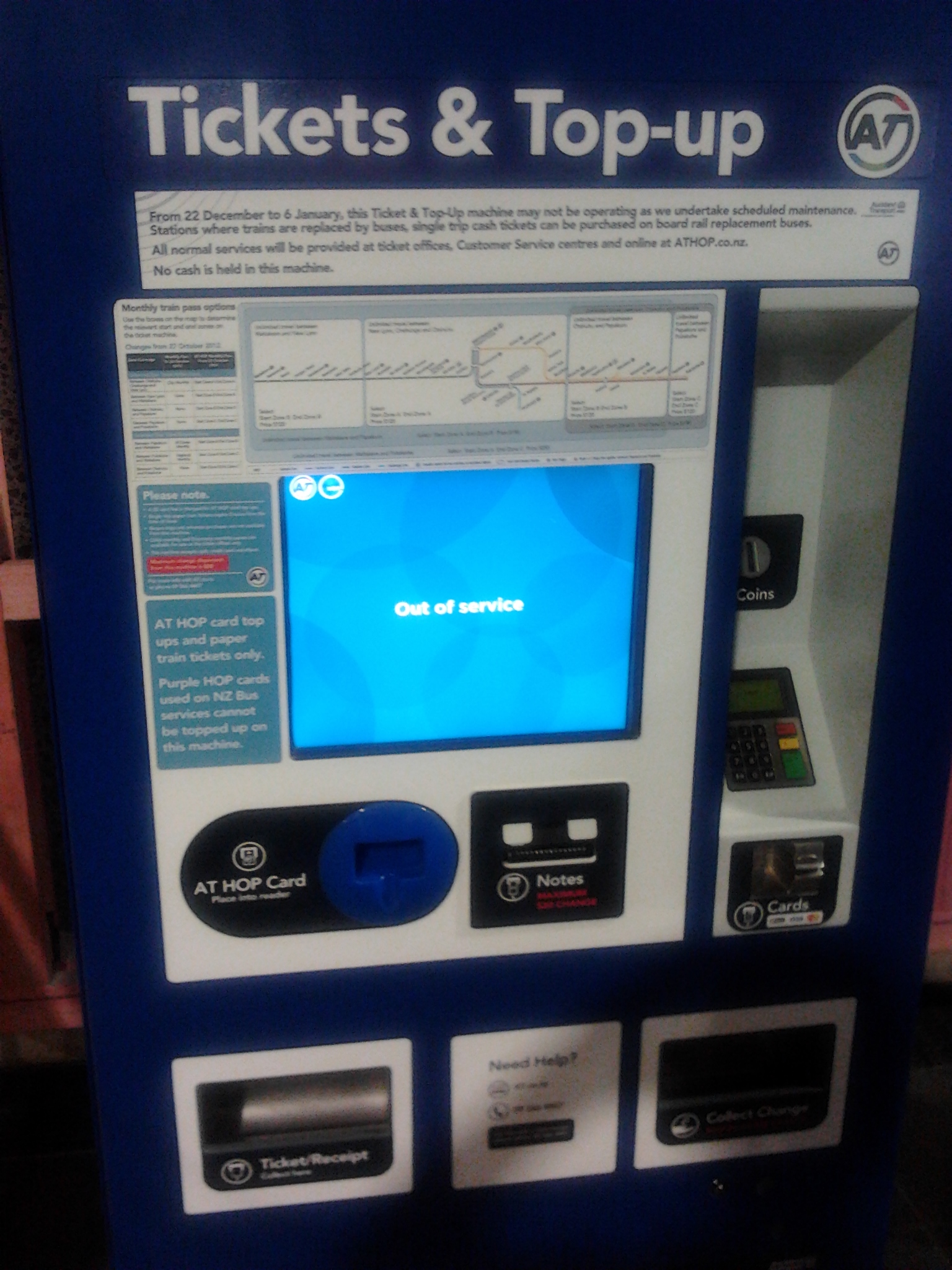
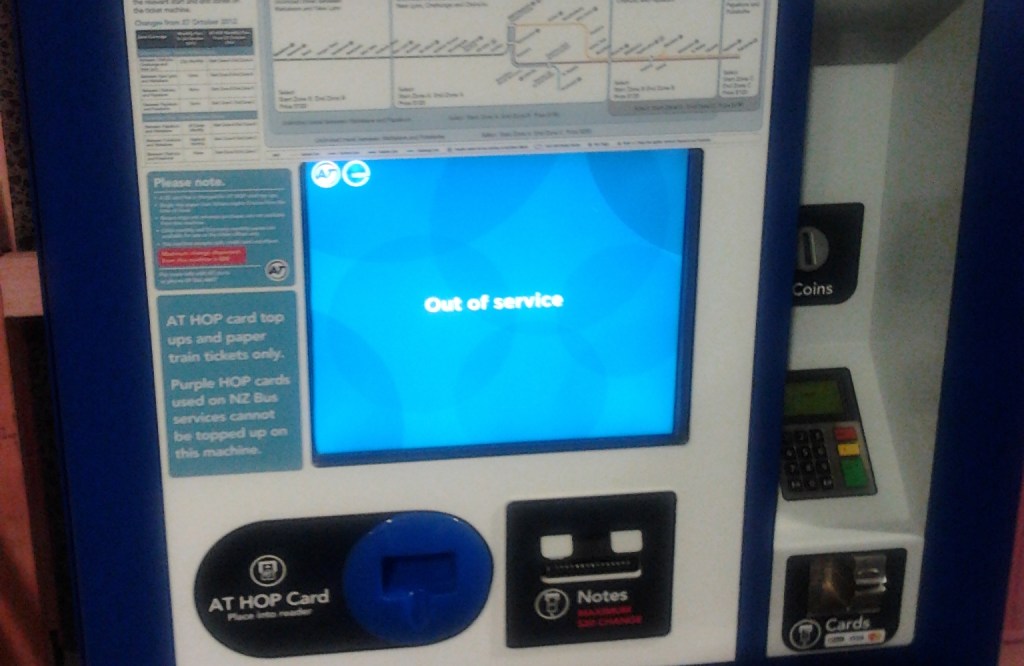
Yes the sole machine was out of order, however tech support had been notified 10mins earlier

Well I managed to personally stave off a fare rise for AT-HOP care users in September last year (Fare Increase Ctd) for rail users. However, this time no such luck – you are going to be lugged with it this time around.

From the NZ Herald this morning after AT announced it last yesterday

Students bear the brunt of Auckland public transport fare rises

Auckland Transport has been accused of targeting students with public transport fare rises that will also affect thousands of Hop and multi-trip ticket buyers.

Auckland Transport – which waited until late yesterday to announce changes approved by its board two months ago – will lift cash fares for tertiary students by between 7c and 40c a trip on June 3.

Adults who use Hop cards on trains or 10-trip tickets on buses also face fare rises of 2c to 22c a ride.

Ten-trip tickets on inner harbour ferry trips such as from Devonport, Bayswater and Birkenhead to the city will also rise by up to $2, but water transport will become considerably cheaper for Hop card users.

A single trip fare for a Hop card user from Devonport to the city will fall from $5.40c to $4.10c compared with an unchanged cash price of $6, but ten-trip tickets will rise to $41.

That is to align Hop cards with multi-trip tickets, which Auckland Transport ultimately wants to scrap in favour of seamless travel across ferries, trains and buses.

Public transport operations manager Mark Lambert said close to 50,000 public transport users could be affected. The changes were required before Hop cards were rolled out to the city’s buses between June 23 and November, he said.

Auckland Council transport chairman Mike Lee asked why fares could not be aligned downward, particularly on trains.

“It seems the most loyal passengers are being targeted – students and those taking multiple trips.”

Auckland had the highest public transport fares of any Australasian city and students were “a key part of our market”, he said.

Mr Lambert said an increase in the student discount from 20 per cent to 40 per cent in 2008 proved highly effective in lifting demand and getting cars off the road, but there was a limit to ratepayer subsidies.

Auckland University Students’ Association president Daniel Haines said the fare rises appeared aimed at those who could least afford to pre-load Hop cards for multiple trips.

He said transport was the second highest cost facing students, after accommodation, and the increases would hit those who faced long trips from suburbs offering lower rents.
• For detailed information about fare changes, visit maxx.co.nz.

I remember fighting tooth and nail to retain the existing fares seen here below rather than having AT-HOP users pay a technical rise as AT were to flat line the discount rates at 10% right across the board

Savings with AT HOP

Adult Child/Accessible Tertiary
Cash fare HOP fare You Save! Cash fare HOP fare You Save! Cash fare HOP fare You Save!
1 stage $1.90 $1.60 16% $1.10 $0.90 18% $1.90 $1.10 42%
2 stage $3.40 $3.00 12% $2.00 $1.70 15% $3.40 $2.10 38%
3 stage $4.50 $4.05 10% $2.60 $2.29 12% $4.50 $2.79 38%
4 stage $5.60 $5.04 10% $3.40 $3.00 12% $5.60 $3.47 38%
5 stage $6.80 $6.00 12% $4.00 $3.55 11% $6.80 $4.21 38%
6 stage $7.90 $6.90 13% $4.50 $4.05 10% $7.90 $4.75 40%
7 stage $9.00 $8.00 11% $5.30 $4.75 10% $9.00 $5.58 38%
8 stage $10.30 $9.05 12% $6.10 $5.44 11% $10.30 $6.38 38%


I believe the new fare guide is not out but reading the material from AT properly you have:

  • Cash fares remaining the same
  • AT-HOP card fares going up as the percentage discount level is lowered across most if not all areas.

So rather than targeting the cash users and hiking the cash fares (if the actual fares did need to go up in the first place) which would move people over to AT-HOP, Auckland Transport go and hit “the little guy” who is already on AT-HOP. Ouch and nasty!

The AT-HOP fare rise also seems to be the exact opposite of the Deloitte HOP review would suggest


One wonders what the thinking was behind the latest move?


The Karaka Collective Presentation

Musings on the presentation


I have been meaning to get this piece up onto the blog for a while about the Karaka Collective presentation recently. I have not got the Physical Powerpoint presentation on me but, will chase it down from the Collective and upload it to the blog ASAP.


On May 13 at Karaka Hall, Peter Fuller representing the Karaka Collective gave a presentation of the Collective’s “submission” and vision for Karaka West and Karaka North. This also included the Weymouth-Karaka Bridge which seems to be causing enough upset from both sides of the harbour.

I have been asked for comments on the meeting as I was there. These are my thoughts and some responses to queries I got asked which covered both the physical presentation and the subject matter at hand:


The meeting in itself was civil and hats off to residents knowing the issue is both passionate and a sore issue (for both Karaka and Weymouth).
For the presentation it was too long and should have only be at maximum 10 minutes for the matter presented. Anything beyond a 20 minute mark in presentations and you lose the audience. I nodded off at the 20 minute mark to which I decided to go over and start talking to Councillors Fletcher and Penrose on the matter at hand.

I would have recommended to follow what is called a split presentation when giving a talk on material that can be quite heavy or quite extensive.

The split presentation format I used for the Auckland Plan Committee last week in my Manukau Presentation ( https://voakl.net/2013/05/15/the-manukau-presentation/ ) had both a short power point presentation covering the main points and a “booklet” with all the information at hand.

Both the presentation and the booklet is sent to the committee in advance for advanced reading leaving me to go over briefly the main points of my argument. The committee with the booklet in hand then asks questions they might have. It was a useful technique and allowed maximum time for the main purpose; questions or what I like to call dialogue if executed properly.

Peter Fuller should have split the presentation with both a short 10 minute brief covering the main points, followed by a booklet with all the finer details for further reading – and had it released a week in advance. Bloggers like myself would have picked up on this and both republished the information and ran commentary on it.

Although in saying that there is a risk of preempting the Collective’s presentation of information and allowing the residents to form questions before hand. Or allow bloggers like myself to take control of a debate and frame the argument. Risks but risks the Collective will have to take if they want their plan to progress. Also something a particular Herald journalist and elected representatives on the North Shore find out too when they get debunked for utter misrepresentation of information. So the remedy is simple; tell the truth from the beginning and you have nothing to fear. Tell a porker and don’t expect much forgiveness from people nor bloggers in return. The Collective were being honest and their ambitions known.

While the material in Fuller’s presentation was too long and too heavy with the presentation too full of planning and officialdom jargon. It could also be taken that the information presented in a way that was talking down to everyone in the room. So a patronising effect that will chill residents and elected representatives

As for the questions they were pretty good, as for the answers they were not. Fuller was okay with the answering but the other two that were land owners I had real issue with. Their answers were put in a way of both putting down the room and issuing a challenge to the room to “meet them” in the Environment Court which is likely where this issue will end up. I have taken note from Brigid her comment which was (it is public):

“I was at that meeting and there seemed to be a difference between how Bruce Wallace envisioned a Weymouth-Karaka link and what Peter Fuller showed in his presentation. Bruce Wallace seemed to be wanting de facto motorway that would get him quicker to and from the airport and lower congestion on SH1 so he could get to work in under 20mins. However Don McKenzie the traffic expert on the Collective team said any Weymouth-Karaka link would not lessen congestion. And Peter Fuller spoke of a 60-80k Te Irirangi Drive/Te Rakau Drive equivalent. ”


This folks is what you call an effective “Buggers Muddle” – that is a pile of different answers that basically contradict each other to the point oxymoron becomes the norm. Three different answers that would have three very different consequences on that particular bridge. Not entirely confidence material nor helpful for both Auckland Transport and NZTA if they ever decided to run with the project. So lets look at the points individually:


  • Bruce Wallace seemed to be wanting de facto motorway that would get him quicker to and from the airport and lower congestion on SH1 so he could get to work in under 20mins.

Umm no and won’t happen. Auckland Transport and NZTA would have to overcome hell and high water from Southern Auckland to get a de-facto motorway put in and the bridge built. The Benefit Cost Ratio would be below 1.0 owing to the massive environment (physical and social) consequences (mainly negative) to the entire area of the de-facto motorway proposal. The “motorway” would not lower the congestion on State Highway One especially when the Greenfield areas get built up. The only way to bet congestion on State Highway One is to 6-lane the motorway all the way to Drury interchange, get the rail service more effective and efficient, and development some large employment centres close to home (Manukau, Wiri and Drury). If one wants a quick trip to the airport then may I suggest throwing your support and money behind the Airport Line from Manukau Station to the airport. Coupled with the EMU’s you could be there in well 30 minutes without the traffic crap on the roads…


  • However Don McKenzie the traffic expert on the Collective team said any Weymouth-Karaka link would not lessen congestion.

Excuse the language but No Crap Sherlock. It will not lessen congestion any where. All that bridge will do is cause rat running through an established community causing misery and literal hell. Yes I see Weymouth has the strip to allow a 4-lane road but it is now too late for the road. That road and bridge should of been built 50 years ago to 4-lane specifications before Weymouth took firm settlement. The settlement could of then be built around the road and bridge rather than the community now being built around the road. As I said the only way to lessen congestion is what I mentioned above. Through in a proper Regional Public Transport Plan and I would say you could remove all together 33% of the cars off the road at a minimum while still allowing transit choice


  • And Peter Fuller spoke of a 60-80k Te Irirangi Drive/Te Rakau Drive equivalent. “

So an expressway option. Last I looked that the communities around Te Irirangi Drive were built in a way that they were mitigated from the most serious aspects of that road. That is the road was built around the community with green shelter belts and lane ways to access the houses (that is no house has a direct driveway access to Te Irirgani Drive in the new sections of that road). The older sections at the Manukau end of the road and along Te Rakau Drive which do have direct driveway access to the road show the implications of planning not done properly. What we see in the older sections of Te Irirangi Drive with direct driveway access rather than green belts and lane ways off the road is what we would get in Weymouth. Not fun for the residents nor particular safe for an 80km expressway either… It is of note that the Manukau end of Te Irirangi is at 60km/h while the new Botany sections are at 80km/h. That 80km/h section has the greenbelt and lane ways shielding the houses from the road. I wonder if the Collective would be willing to stump the cash up to retrofit Weymouth Road with those lane way shields if they want their bridge built. Probably not, so I wouldn’t want a 80km/h expressway either without the proper mitigation in position FIRST.

In regards to Bruce Wallace (seem to remember him rather well for some odd reason), I don’t particularly care if one has had issues with the old Councils. Most of us would have had crap from the legacy Councils so we know what it is like (Manukau Station being a pet peeve for me with the old Manukau City Council that I am still trying to fix up with the current Council). But what I do care is them short circuiting the RUB process and apparently trying to buy their way into outcomes favouring them via the Unitary Plan.

I did ask the final question for the night regards to the Collective supporting existing and new infrastructure projects before backing the Weymouth Bridge. Those projects include Glenora Road Station, Spartan Road Station, the Manukau Rail South Link, the RPTP with the bus routes and so on. While they said they would and might have done so (meaning I need to dig up submissions), I highly doubt it unless they prove me wrong over the next 7 years.
In saying that I am working on my submission to stave off that bridge as long as possible through a formation of a new regional park on the Karaka side. This has been mentioned before in this blog before

The submission will go up on my blog as soon as its finished.

Otherwise the meeting was handled well by the residents from a group short circuiting the processes the rest of us have to go through via claiming it is for the good of Auckland.


Those were my thoughts in the presentation. As I point out to the Collective, those ARE MY THOUGHTS AND INTERPRETATIONS of that presentation. If the Collective differs to my interpretations they are free to share a guest post – that is less than 2500 words and in plain English. Graphics help and can be facilitated easy into the blog.


In the mean time people do not forget your submission to the Unitary Plan in before May 31 – 5pm


From Dr Lester Levy

Dr Levy writes in the NZ Herald


I caught this piece this morning (while debunking Orsman) from Dr Levy – head of Auckland Transport


Lester Levy: Restoring faith in Auckland’s transport system

Commuters can be assured public transport will be sorted and the service will be one everyone enjoys using.


Far too many Aucklanders have lost faith that there is an alternative to their private car. Photo / Brett Phibbs

EXPAND
Far too many Aucklanders have lost faith that there is an alternative to their private car. Photo / Brett Phibbs

When it comes to transport in Auckland the stakeholders are as many and varied as are the differing and divergent views.

I guess it has always been like this and over many decades ad hoc decisions, decisions half-made, questionable decisions and decisions deferred or never made have severely limited options.

Transport solutions in Auckland are well behind where they should be, but not where we have to stay.

I have been chairman of Auckland Transport for six months. What do I see? Public transport in Auckland is just not yet good enough. The trains do not run frequently enough and frequently they do not run on time. The bus real-time information does not seem real to many, because it is not, a lot of the time.

Peak times on trains and buses are often very crowded and it just seems like there are not enough of them – that is because often there are not. The new AT Hop card has had some issues – these have been very frustrating for passengers


You can read the rest over at the Herald site


I have made mention before of Dr Levy’s mission and drive for both Auckland Transport and Auckland’s Transport here at the blog:

While I can be harsh upon Auckland Transport (AT-HOP, Snapper and the Family Pass being the classics), in the same regard I can praise and work alongside them as well (The Regional Public Transport Plan which is back for consultation). Dr Levy though is right through Auckland losing faith in its public transport (as I covered with the fall off in patronage statistics with rail) and even AT itself. I do not particularly envy Dr Levy’s formidable task in turning AT and the public transport system around but I do praise him to take the task head and hands on. Having seen Dr Levy turn around Auckland Hospital I can have faith he can do it again with Auckland Transport 🙂


In saying that though while I have faith in Dr Levy, I am apprehensive about the Auckland Transport Executive Team headed by CEO David Warburton. I am allowed to feel apprehensive as a human is I have concerns from the executive team not pulling its weight enough to get the changes we need through. The disdain executive members can have for the Auckland Council Transport Committee don’t help me allay that apprehension and I wonder if all the changes required can be pulled off by 2020-2025.


The apprehension against the executive is my private ponderings although I have mentioned them here as I know they will pick up on this.


Still; full praise to Dr Levy and his mission.


If the RPTP can be pulled off right (so far it has (and I have been involved in it through submissions and hearings) then that should be a big boost for AT and the transport system in Auckland. In saying that I better brush up and prepare my submission for the RPTP southern sector feedback AT is asking after. Need to get those bus routes right you know 😉


Auckland Transport and Public Transport

Slick New Video on our Public Transport


If it was not for Budget 2013 and that Much-Ado-About-Nothing Accord causing grief in Auckland I would of gotten this post up yesterday. None the less Auckland Transport has released a rather slick video on how IT sees public transport post 2016. This is covered in the Regional Public Transport Plan (RPTP) and is stuff I have commented and submitted on before.

Take a look at the video from Auckland Transport which can be seen at their “New Public Transport Network” page.


Also take note of these wee facts:

Benefits of a simpler connected network will include:

  • Services at least every 15 minutes on the frequent network
  • Easier to understand
  • Access to more destinations across Auckland
  • Reduced waiting times

In October 2012, Auckland Transport called for Aucklanders to have their say on the future of public transport in our city. A total of 719 submissions were received on the draft Regional Public Transport Plan, which included the proposed new structure for Auckland’s public transport network. Approximately 70 per cent of submissions supported the proposed direction taken.

This schematic map of the proposed frequent network (PDF 250kb)includes the Southern, Eastern and Western rail lines, the Northern busway and high-frequency bus routes connecting major centres. This map shows only services (bus, rail and ferry) intended to operate at least every 15 minutes, 7am – 7pm, 7 days a week. Services will continue to operate outside these hours at lower frequencies. Other ferry, local bus and peak bus services will also operate.


I have not agreed or disagreed with what AT are proposing at this point and time. But, as mentioned earlier I have submitted and attended hearings on the RPTP thus far with another round of consultation coming next month.

Previous commentary and my presentation can be found at:


As also noted AT is beginning the next round of RPTP consultation starting with the south

Areas ​Consultation ​Implementation
South Auckland 19 June 2013 to
2 August 2013
Mid – end 2014​
North Auckland​ Early 2014​ Mid 2015​
Central, East and West Auckland Late 2014​ Mid 2016​


Also please take note of the Auckland Council Transport Committee and its deliberations over the RPTP at its Wednesday meeting:


So let see if proof is in the pudding after the next round of consultation with AT on public transport


As for things like the Manukau South Rail Link, Glenora Road Station, Electrification to Pukekohe, and Grade Separation of rail crossings which are all hot button topics and priority wants in the South; WORKING ON IT – still.


BEN ROSS : AUCKLAND

BR:AKL: Bring Well Managed Progress

The Unitary Plan: Bringing Change

Auckland: 2013 – OUR CITY, OUR CALL