Tag: transportation

10-26% Rail Utilisation?

Ummm – Bit Short Are We Not


After returning from the Papakura Unitary Plan feedback session this morning which was highly informative as I went one on two with Council Officers. I even learnt that Browns Bay on the North Shore who think they are in for 6-8 storey buildings are only in for four storey buildings looking at The Clunker in-depth. However, more on The Clunker later.


After my dialogue on The Unitary plan I had a discussion with Angela Dalton of Manurewa Local Board and two Papakura Local Board members (who I will look up their names shortly). The discussion came to the Glenora Road Rail Station at Addison, Takanini; 5-minutes from where I live. I was told that Auckland Transport are not doing Glenora Road Station AT ALL because of the $35 million cost for the station. $6 million for platforms, shelters, park and ride, kiss and ride and bus interchange (so a fully fledged station minus people manning it); $29 million for the grade-separation at Walters Road 50 metres south. AT forecasts the patronage figures at 952 daily using Glenora Road which I called Bollocks on straight away as a justification in not building the station.

I will also write a separate post on the Glenora Road situation and call AT on this as I know that station will attract at minimum five times that amount (952) as a conservative figure as the area grows (regardless of Takanini closing down or not).


But the 952 gives light to a mega-embarrassing situation that has not been aired yet on the Auckland laundry line. That is our honestly shameful rail utilisation figures which on average over 363 days a year (there are no passenger trains on Good Friday and Christmas Day) stands at 27,000 a day or 20.5% of potential patronage if we ran every train on average 67% full day in day out (see explanation at bottom of post). 

Let me run the numbers with you:


The Numbers using 325 services a day (average) per Auckland Transport


On existing services (there are 325 a day average according to the Fare Evasion Modelling) AT expects around 30,000 passengers a day. That means 92 passengers a service and our current diesel fleet holds anywhere between 350 to 750 depending on the train class (safe loading – not crush loadings). So 92 passengers means the train is anywhere between 12% full to 26% full AS AN AVERAGE as I know some trains are packed out.

Using 10 million as the rolling annual target we are at 27,000 passengers a day which gives an actual utilisation AVERAGE (weekends are in here) of 10-23% and we need around 40,000,000 rail passenger trips annually using the existing diesel fleet if the utilisation was at 67% (rather than 100% – see explanation below)


If we take the averages across the fleet (which with out diesels it does not make this easy as we have a heterogeneous fleet currently) then followed by the new EMU fleet all running at the maximum 6-car – top and tail config (two EMU-3s put together) this happens:

If the average diesel train holds 507 passengers average and 67% puts it at 339 passengers required, multiply that out by 325 services means you need Monday to Thursday 110,099 passengers a day to get ANY WHERE near turn over rates mentioned above. And yes I know the ADL-2 and ADK-4 can not hold 507 passengers – but this is averages here made out from the SA/SD 6 car sets holding 750 passengers. 


Let me try this for the EMU as EMU-6 car sets which hold 750 passengers

67% means 502 passengers and across the existing 325 services means you need: 163,150 passengers DAILY to make this viable, while AT is playing around with 30,000 a day or 92 passengers per train service. This means for an EMU-6-car running at an average of 12% full.

10-26% utilisation rate?

As a grand total figure we need with the EMU’s all running on just the existing provisions moving about 60 million rail passenger trips a year (this is at the 67% average utilisation rate) (so 6 time more than now) and we have not even stepped up the services yet to well over 400/day Monday to Friday at the minimum as planned.

 
This is mega embarrassing folks to have our existing rail utilisation at any where between 10-26% (92 passengers average for every single service – and depending on train type) per service which means Auckland is at no more than 18% of rail utilisation compared to its minimum viable capacity which stands at 67% of total maximum capacity – if we were carrying the 30,000 AT is modelling for at the moment. However remember as I mentioned above only 27,000 approximate people on average use the trains a day (10 million divided by 363 days)  which means knock another 2% off the utilisation rates.


I did say mega embarrassing now didn’t I? To be honest as an Aucklander I would be deeply embarrassed at the situation before us right now with our heavy rail. We have seen growth to above 10 million only for it to slip back below that milestone in February this year. But we seem to be stuck in a rut in getting the figures where it should be. AT forecasted the annual rail passenger trips near the 12,500,000 mark which means around 34,500 a day or a utilisation rate of around 23%, but that has slipped to 10.5 million so the figures fall back to around 30,000 a day.

We have a long way to go folks to get near 60 million annual rail passenger trips (might as well use EMU figures now with them coming on-stream soon) (60 million at 67% average utilisation across ALL 325 existing services) – which means the theoretical capacity stands at 90 million.


Still 9,996,066 annual rail passenger tips for the existing diesels and we need 40,000,000 for it to be viable, 60,000,000 when the EMU’s are all on stream. Remember this total average utilisation figure rises if you run more services. For example say the CRL is complete and all EMUs are running as 6-car sets holding a maximum capacity of 750 passengers and we go to 410 services average a day, 363 days a year. That means at 67% utilisation across  the services one would need 74,500,000 annual trips approximate for the entire operation to be viable. The Auckland Plan calls for by 2041, 140 million trips to be made a year by public transport – all modes…


Note: my figures are expressed as a percentage of 67% average utilisation or carrying numbers (which is 67% of the total maximum capacity) – not the actual total maximum capacity numbers (which would be 100% utilisation or carrying numbers). 67% was derived from the theoretical minimum all services would have to carry as an average for the Auckland Metro Rail system to be viable, and takes into account the system will be: 

  1. never at 100% utilisation across all services

  2. balances out across the services where are individual services are at 95-105% utilisation and others are around the 10% currently and also projected. It basically allows for a generous spread and average from varying patronage numbers per individual service.


So with this very embarrassing situation that makes me deeply embarrassed as an Aucklander to be confronted by this


The situation also reinforces my released Statement on Auckland’s Transport this morning which you can read below in the Scribd embed


I await Auckland Transport’s reply
 

Integrated Transport Program Approved

$60 Billion – 30 year ITP Approved


I was at the Auckland Transport Board meeting today listening in on the Integrated Transport Program as well as (and mainly) any blood-letting from the latest patronage figures I alluded to earlier this week.


The AT Board did today however, did approve the $60 billion – 30 year Integrated Transport Program. In short the ITP brings together finally a single approach in dealing with all of Auckland‘s transport system from road to rail, car to train, cyclist to walker to ferry. The ITP also lists the amount of money needed – an eye watering $60 billion to maintain and renew existing transport assets while also investing in new transport assets as well. But as the ITP report states as embedded below; the funding is $15 billion short of the $60 billion needed. To make matters more interesting despite the investment via the ITP, Auckland will still be apparently worse off – go figure?


I’ll investigate this some more over Easter but for now happy reading


The Integrated Transport Program


The Rural Urban Boundary – South End

The Unitary Plan


And


The Southern Rural Urban Boundary


I have been meaning to get this up this morning but the perennial issue called Auckland Transport has being cropping up again.


So the Unitary Plan is out for informal feedback from Auckland and we have central government sticking its nose in our affairs when it should learn to butt out. Commentary on the Unitary thus far has been rather weak on the actual issues at hand: the rules, the zones, the RUB, the infrastructure deficit which is eye watering, and how to deliver all this from (at this rate) September. Then again once our Deputy Mayor gets MP Nick Smith out of the city and tell him to butt out as he is being counter-productive attention might be drawn back to the rule book that affects the lives and businesses of Aucklanders.


As mentioned before I went away on holiday, commentary on the Unitary Plan will start as BR:AKL looks at the issues at hand. At the same time a series on an alternative to the Unitary Plan will run in parallel to Unitary Plan commentary. Today I am going to look at the Southern Rural Urban boundary where upwards of some 57,400 new Greenfield dwellings could end up depending on the option. This kind of Greenfield development stems from the Auckland Plan calling for 60% of urban development to happen in Brownfield land with the other 40% in new Greenfield land. The Southern Rural Urban Boundary (RUB) is one such spot (the others being in the North and North West of Auckland) where some of that 40% is meant to go.


For those wondering what a Rural Urban Boundary is, please check THIS LINK from the Unitary Plan on its description.


As for the Southern RUB there are three development options Auckland can take with this Greenfield Land (which is 15 minutes away from where I live by car). You can see all three options layered over a GIS Map and a GIS Map with an Issues and Constraints Overlay as well as each of the three options below in the embed below:

The two GIS maps (pages one and two) have dwelling capacity limits for each of the Greenfield zones depending on which option is taken.


Personally I am in favour of the Draft Southern RUB Options – Corridor Focus (Page 4 of the embed) which contains primary urban development to Drury and Karaka (Core’s K and D), along the State Highway 22 and North Island Main Trunk Line rail corridor, the North East Pukekohe flank, and the Pukekohe South East flank. This option keeps the main development either near existing development or along a transit corridor making infrastructure provisions (Drury and Paerata Rail Stations) and access more easier than the other options such as those that include Karaka North and West. Per The Unitary Plan there is an option to retain a green belt between Pukekohe and Paerata which would provide a wildlife corridor as well as park space. While development is kept away from the highly valuable Pahurehure Inlet which according to the maps contains colonies of wading sea birds. In any case that area slated as Karaka North and West if need be can be converted either into lifestyle blocks with strict covenants or over time into a new regional park and green lung for the ever-growing Auckland (which is what I would prefer Council would do (like an Ambury Farm or Puhinui Reserve set up)).

I have also noted as potential transport link from Whangapouri to Weymouth via a new bridge over the inlet as well as talk of a new waste water treatment plant. With me preferring the corridor option thus Karaka West and North not being developed – but actually wanting to be flipped over to lifestyle blocks or even better a regional reserve I can not see the need for a transit link through that area connecting to Weymouth. That link would create a rat-run from State Highway 20 at the Cavendish Drive Interchange, down Roscommon and Weymouth Roads (Route 17), over the new bridge, down the new transit link and through to State Highway 22 just north of Paerata rather than containing it to State Highways 1 and 22. That kind of rat running would lower the amenity of the new Greenfield developments and do nothing to solve congestion issues. As for the waste water treatment plant, well with Karaka North and West no longer under development you can away plop the new plant there out of the urban road but near the potential outfall site.


Submission wise I am going to follow through and “recommend” to Auckland Council that the Corridor Option for the RUB being the preferred southern Greenfield development options, providing there is:

  • A green belt maintained between Pukekohe and Paerata
  • New waste water treatment plant is built
  • That transit link over the Inlet is not built
  • What was labelled Karaka North and West either be allowed to be converted to Lifestyle blocks or even better a regional reserve seeming wading birds live in those areas
  • And that Auckland Transport will build the Drury and Paerata Mass Transit Interchanges (rail and bus station, and park and ride)


I will keep tabs on this and see which way Council swings on this once the Unitary Plan becomes near operational – whenever that may be

Rail Patronage Below 10 Million

STOP PRESS: Auckland‘s Rail Patronage Below 10 Million


Just in from Auckland Transport. I have just scoured the latest Auckland Transport Patronage Figures for ‘as-of’ February 2013 especially for rail.


There was a time two years ago when I was side by side with the mayor while working for Veolia Transport Auckland feeling proud and delighted with the Mayor that we had hit our 10 millionth rail passenger marking a new age for Auckland’s rail network. There was even cake and a photo of the occasion somewhere too.


However I read the latest rail patronage figures this evening released by AT at their website. You can see the figures in the embed below but I bring your attention to page ten of twenty-seven – the rail figures which stand at 9,996,066 today. A slippage from the 10,900,000 peak in August 2012 to now just under 10 million.


I wonder what AT will trot out on Wednesday at that meeting with now basically half the city alerted after the figures went around Twitter and Facebook…


That Statistics Report:


And as Patrick Reynolds on Twitter said:

  1. @BenRoss_AKL some crazy fare dodging going on because of generous gating and policing processes. #akrail

Ben Ross ‏@BenRoss_AKL10m

@pv_reynolds you said it not me. I gather fare dodging is at 16-28%


Panic stations any one?

Southern Motorway Gridlock

Bring Back the Eastern Highway?


And so it happened, an accident on the southbound lanes of the Southern Motorway (State Highway One) on the Newmarket Viaduct causing absolute gridlock for hours on end – and it even delayed the start of the Breakers game to boot.

You can see (what is most likely to have been caused by hopeless driving Auckland is known for) the accident and its absolute chaos from the NZ Herald along with a bonus video

From the NZH:

How one crash caused gridlock chaos

By Amelia Wade

5:30 AM Friday Mar 8, 2013

Inner-city Auckland traffic was brought to a virtual standstill last night after a motorway crash – gridlock that the Automobile Association described as the worst it had seen.

A van crashed into the back of a truck in the southbound fast lane on the Southern Motorway at Newmarket at 3.50pm, seriously injuring a man.

More than two hours later, traffic on almost all of the city’s arterial routes was gridlocked, with buses backed up in city streets and motorists reporting speeds of less than 10km/h.

Journeys that normally took 15 minutes were taking more than an hour.

Automobile Association traffic spokesman Phil Allen said he had never seen traffic so bad in central Auckland.

Are you sick of Auckland’s traffic problems? Send us your commuting tales of woe and any ideas you have on how to fix Auckland’s traffic jams here.

The association launched traffic-mapping technology on its site 18 months ago. Routes marked in black show where traffic is moving at under 25 per cent of the speed limit.

You can read the rest and watch the video over at the NZH.


I was fortunate enough to have returned from the success at the Strategy and Finance Committee ahead of that traffic disaster yesterday however it is going to highlight a rather sore point?


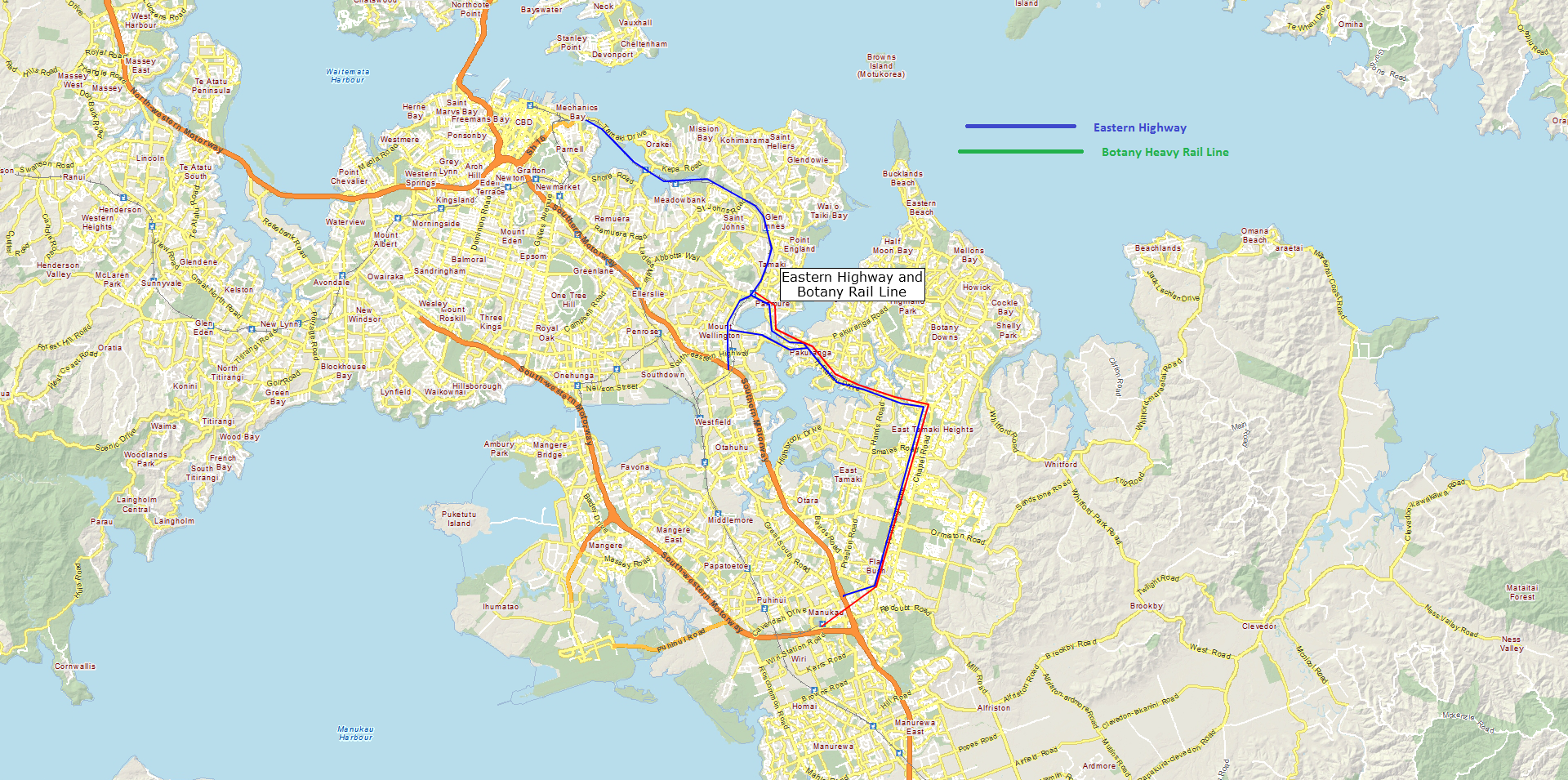
Would of the much vaunted four lane Eastern Highway expressway coupled with cycle-ways and even the Botany (heavy rail) Line alleviate some (not all but some) of the chaos yesterday by giving a viable bypass for those heading south out of the CBD. Those coming from the north would have used the Western Ring Route (State Highways 16 and 20) if it had been completed by now as an extra backup.


The Eastern Highway and Botany Line basically followed this trajectory before its mothballing in 2004

Eastern Highway and Botany Line


Click for full resolution


I have the original EASTDOR report into the four options available for the Eastern Highway and will get them uploaded when I return from Australia.

But for now just ponder to yourself; The Eastern Highway – that critical back up for the CBD we now miss.


Of course I am waiting for the fringe brigades from both the pro road, and pro public transport and nothing else to pipe up and basically kill the debate before it starts…


Just remember folks – the Eastern Highway provided an absolute full suite of actual integrated transport options such as: road, freight way, bus priorities, cycle ways and even heavy rail to a part of Auckland not served by rail as of current. I suppose I could have the last laugh after the project was mothballed in 2004 and how (as it would have been completed by now) it could have made a pure crap day just that slightly bit better for those stuck last night…


Patronage Below Forecast

Rail Patronage Some Millions Below Forecast


No wonder why I was asked for the Auckland public transport patronage statistics in the weekend, an article has popped up on Radio New Zealand talking explicitly about how total public transport patronage (so across all modes) is going to be something like 3.6 million under forecast for the Financial Cycle with rail making up two million of that shortfall as of current. And no I was not talking to Radio NZ, someone else had asked.

You can listen to the article here from Radio NZ


I could go into a whole spiel from what was said in the article but that is wasting pixels while I am busy with a project at the moment regarding P/T.

However if one wants a quick recap on some grumbles that cause patronage to fall out through the floor then check these two recent articles from the blog:


One last thing when listening to the radio article, see if you can pick up on why the Fare Review I mentioned in my ‘Fare Rise on Auckland Rail’ post did not become public when it was meant to. Case of oops applies in that case 😉