Beyond the Funnel: Resolving the Paradoxes of New Zealand’s National Policy Direction
Last week the Illustrative National Policy Direction was released for reading, review and submissions. You can see the landing page from the Ministry of Cities, Environment, Regions and Transport (can they just call it the Planning Ministry next time please) here: Testing the approach to National Policy Direction. The actual document will be at the bottom of this post. Per the Ministry:
The illustrative NPD has been developed to show how national direction could operate under the proposed planning system. It is designed to improve understanding of how national priorities may influence future planning decisions and regional spatial planning.
Thus they want feedback on what the NDP’s strength’s, opportunities and challenges are, and how improvements could be made.
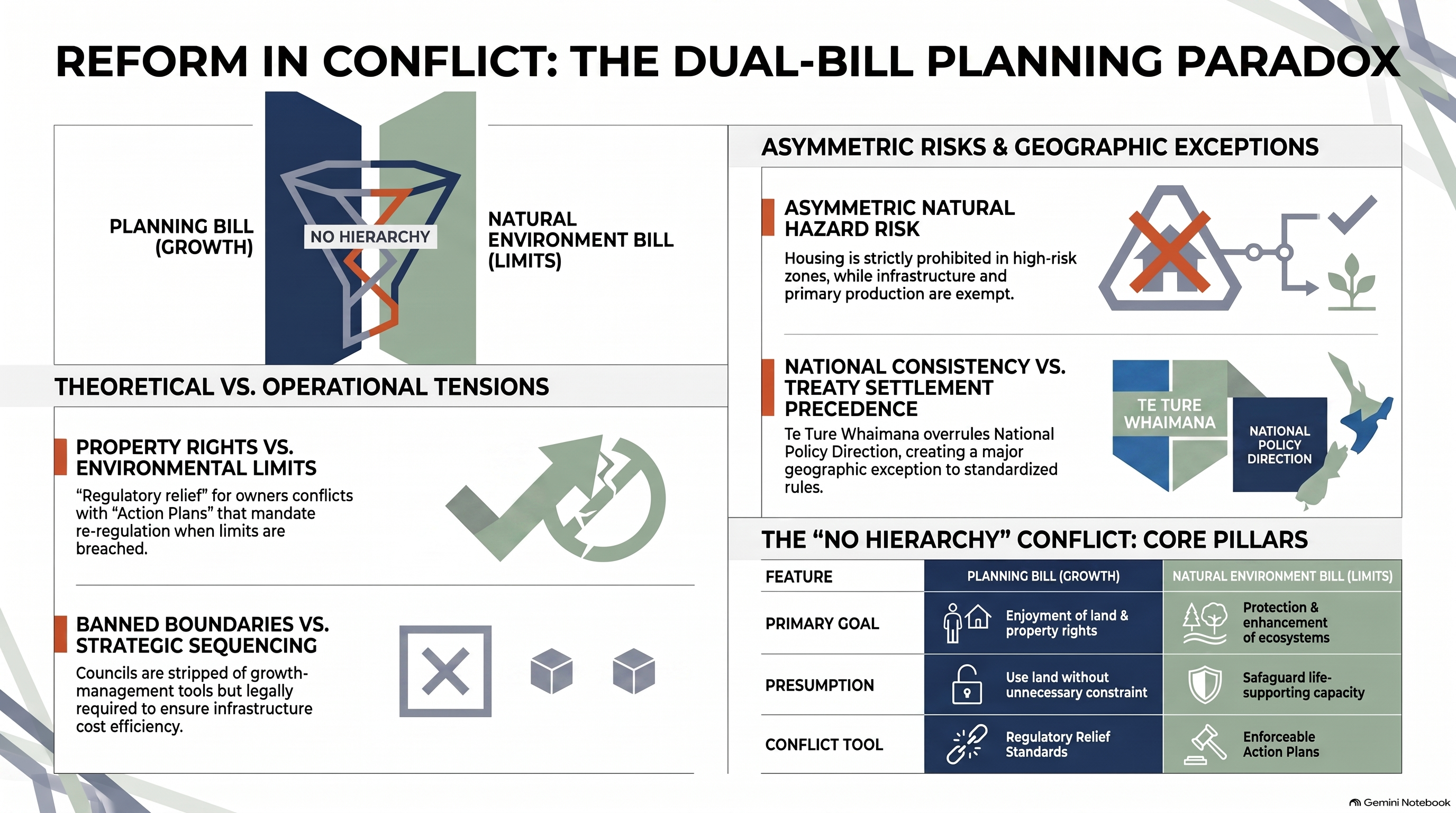
Problem though is the entire document is one big paradox with sections contradicting each other as the infographic highlights:
So what to do? The fixes were pretty straight forward:
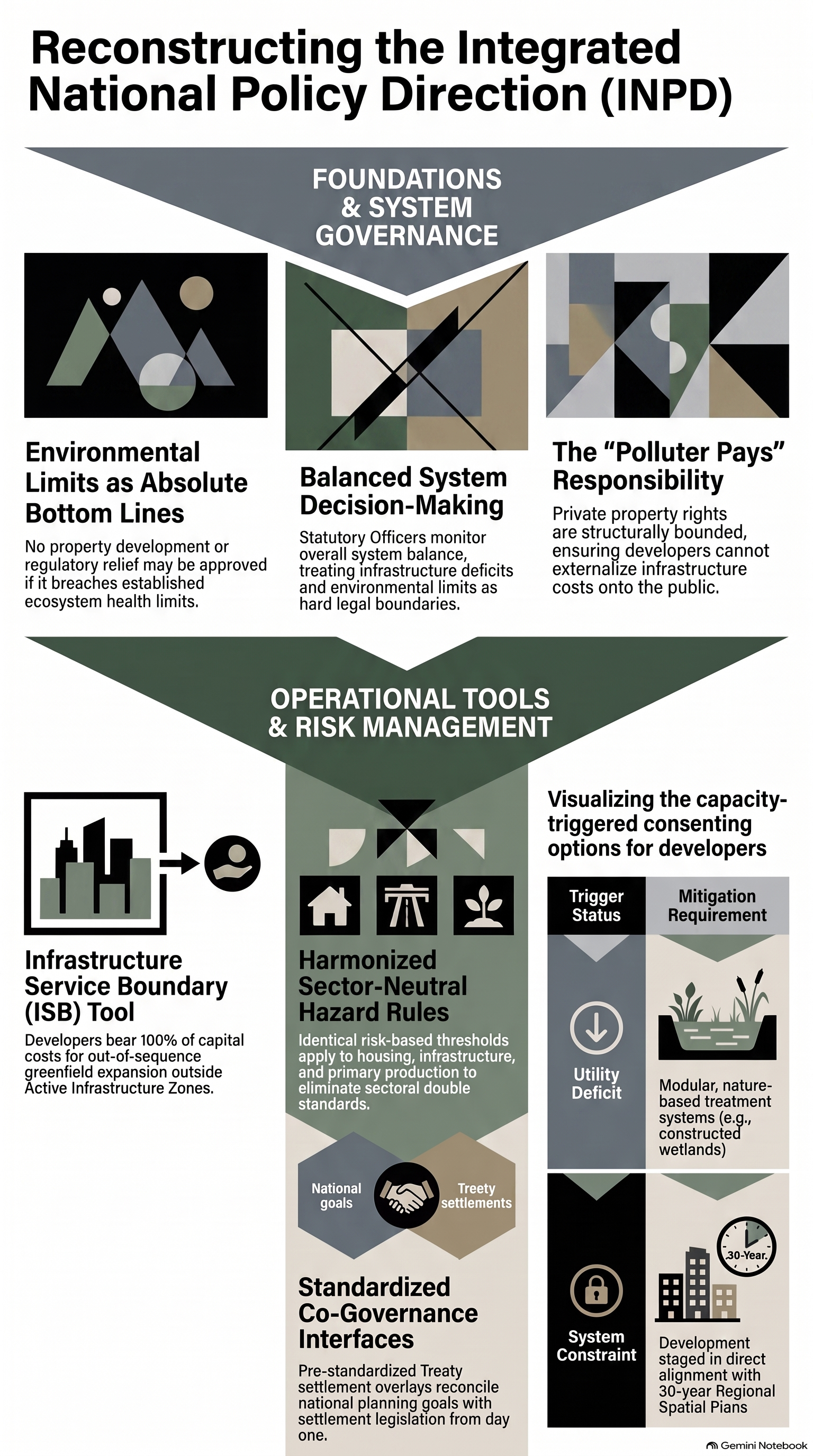
Now if the fixes are looking familiar that is because they are. The AI without prompt looked back at the Japan Land Use Law Act 1974 especially around Infrastructure and Environmental Limits being bottom lines. Before diving into the explainer in the rest of the blog, the accompanying Share-Decks highlight the paradoxes of the National Policy Direction and the potential fixes.
The Paradox and Contradictions of the NPD
The Possible Fixes
The Deep-Dive
1. The Strategic Shift: From Fragmented Regulation to the Integrated Funnel
The transition from the reactive, effects-based complexities of the Resource Management Act (RMA) to a “funnel” model represents a foundational pivot toward national consistency. This shift is not merely administrative; it is a proactive strategic framework designed to lift productivity and living standards by providing the certainty required for high-stakes investment. The architecture relies on the Planning Bill and the Natural Environment Bill as distinct but complementary pillars: while the Planning Bill focuses on the enjoyment of land and economic growth, the Natural Environment Bill provides the essential floor for ecological health.
The “funnel” is designed to systematically narrow the scope of debate and litigation through four descending layers:
- National Policy Direction (NPD): The top-tier layer where the Government articulates national priorities and high-level directives.
- National Standards and Regulations: These convert priorities into consistent rules, methods, and plan content to ensure regional uniformity.
- Regional Spatial Plans: These translate the NPD into a 30-year strategic vision, sequencing growth and infrastructure at the regional scale.
- Land Use and Natural Environment Plans: The final implementation layer where local zoning rules, overlays, and environmental limits are codified.
While this design is theoretically robust, practical frictions within the illustrative directives demonstrate that the current model abdicates national leadership by delegating high-stakes political trade-offs to local planners.
2. The “No Hierarchy” Problem: Evaluating the Four Core Systemic Paradoxes
The current planning reform operates on a “no hierarchy” principle, placing economic growth and environmental protection on equal statutory footing. This approach creates operational gridlock. By leaving competing goals unresolved at the top of the policy funnel, the system introduces strategic volatility that destroys investor confidence.
Analysis reveals four primary paradoxes within the current illustrative directives:
- The Regulatory Relief Loop: Under CC-Directive 1, private land use is enabled with “regulatory relief” available if environmental rules “significantly constrain” development. However, PP-Directive 1.3 mandates enforceable mechanisms to remedy breaches of environmental limits. This creates a regulatory whiplash where environmental health is undermined by relief grants only to be reclaimed by rigid, non-negotiable re-regulation.
- The Infrastructure Liability Paradox: HD-Directive 1.5 bans urban growth boundaries to foster competition, yet CC-Directive 7 mandates the minimization of long-term public infrastructure costs. The strategic consequence is a debt-trap for local authorities, as developers initiate high-cost, dispersed sprawl while the legal and financial burden of extending public networks is shifted asymmetrically to ratepayers.
- Asymmetric Hazard Risk: There is a stark double standard between HD-Directive 4.1, which mandates strict avoidance of residential housing in high-risk zones, and INFR-Directive 3.1, which prohibits councils from restricting infrastructure in those same areas. This creates an asymmetric double standard and a stranded asset risk, where public funds are spent on roads and pipes through hazard zones where no homes can legally be built.
- Standardization vs. Settlement Precedence: While the system promises national consistency, it acknowledges that in catchments like the Waikato, Te Ture Whaimana prevails over the NPD. This fragmentation of the “standardized” promise means investors must navigate localized regional overrides, reintroducing the very complexity the reform sought to eliminate.
These structural failures necessitate the transition to a sequenced, legally cohesive framework: The Integrated National Policy Direction (INPD).
3. Reconstructing the Framework: The Foundations of the INPD
To provide the stability required for sustainable development, the “no hierarchy” model must be replaced by explicit “tie-breaker” rules. The Integrated National Policy Direction (INPD) Framework internalizes the responsibility for maintaining the commons, ensuring that market growth does not liquidate the public ledger or the environment.
The “Rules of the Game” for the reconstructed INPD are:
- Rule 1: Baseline Supremacy (The Environmental Floor): To close the regulatory relief loop, environmental limits regarding air, water, soil, and ecosystems are established as absolute bottom lines.
The Fix: A new directive explicitly states: “No property development or regulatory relief mechanism may be approved if it causes or accelerates the breach of an established environmental limit.”
- Rule 2: Integrated Property Rights: Private property rights are structurally bounded by a “polluter pays” and “costs-fall-where-they-are-created” principle. This ensures that the responsibility for the commons is internalized by those who profit from development, preventing the externalization of costs onto the public.
This hierarchy provides the legal grounding to decouple land use from infrastructure debt.
4. Smart Land Abundance: Fixing the Infrastructure Liability Paradox
Strategic land abundance requires decoupling land-use approvals from council-funded infrastructure capacity to prevent “unfunded mandates” from bankrupting local authorities. The Infrastructure Service Boundary (ISB) Tool replaces the blanket ban on growth boundaries with a clear funding split:
- Active Infrastructure Zones (AIZs): Areas where councils have fully funded and sequenced bulk infrastructure according to the 30-year Regional Spatial Plan.
- Developer-Funded Growth Zones (DFGZs): Unconstrained land where expansion is permitted, provided the developer bears 100% of the capital and downstream costs to connect to public networks.
To resolve current constraints, a “Capacity-Triggered Consenting” mechanism replaces the need for slow plan changes, addressing the failures of HD-Directive 1.4. If a utility network is in deficit, development is approved if the developer installs modular, nature-based treatment systems (NBS) at their own cost. Crucially, this is a power shift: if modular solutions are utilized, councils cannot use infrastructure deficits as a legal excuse to delay the consent.
5. Harmonizing Hazard Risk: Closing the Asymmetric Safety Gap
Safety thresholds must be Sector-Neutral to protect public networks and community resilience. The proposed Standardized Safety Thresholds eliminate the double standard that allows infrastructure to be built where housing is banned, preventing Public Emergency Bailouts.
The Operational Risk-Avoidance Rules are:
- Category 1 (Very High Risk): Uniform Avoidance is applied across all sectors—housing, primary production, and new lifeline utilities—unless an absolute functional need is proven.
- Category 2 (High Risk): Any development must provide a certified “Life-Safety and Asset-Redundancy Engineering Report.” This high-hurdle requirement ensures the asset can withstand climate-adjusted events without service collapse or the need for public rescue funds.
6. Standardized Co-Governance: Integrating Treaty Partnerships
To eliminate regulatory fragmentation, Treaty settlement precedence must be integrated directly into the national “funnel.” The INPD introduces “Treaty Settlement Overlays” into the NPD to provide geographic certainty.
The operational fix for the Waikato Catchment Special Planning Zone (WCSPZ) involves pre-adjusting national zoning templates to reconcile Te Ture Whaimana river-clean-up standards from day one. Developers in the Waikato will no longer face unpredictable overrides; they will operate under a pre-standardized ruleset that aligns national goals with settlement legislation. This certainty facilitates the deployment of innovative, nature-based infrastructure.
7. Nature-Based Solutions: Resolving Deficits Without Blocking Growth
Nature-based solutions (NBS) act as a strategic bypass for infrastructure bottlenecks, bridging the gap between housing demand and environmental limits. Under PV-Directive 1.2 and PP-Directive 1.5, tools like constructed wetlands are enabled as “temporary or future provisions” across both urban and rural (farm-scale) environments.
The strategic value of NBS is captured in four areas:
- Legal Bypass: They provide a mechanism to keep development moving in areas with utility constraints without waiting for “grey” infrastructure upgrades.
- Environmental Shielding: Wetlands act as a proactive buffer, filtering contaminants to prevent legally binding limit breaches.
- Strategic Sequencing: They allow councils to manage capacity overload while engineering a localized buffer.
- Biodiversity Dividends: These solutions capture co-benefits (PV-Directive 2.6c) by supporting indigenous habitats and ecological corridors.
8. The New Governance: From Market Permissiveness to System Balance
The final requirement for system balance is the reformed role of the Urban Land Market Statutory Officer. This officer is no longer a “permissiveness cheerleader” but a monitor of Overall System Balance.
While the officer evaluates land efficiency, they must respect “Hard Legal Boundaries.” The officer is explicitly forbidden from penalizing councils for restricting land capacity if allowing further growth would trigger an environmental limit breach or exceed infrastructure capacity. This governance shift provides a “shield” for local authorities protecting the long-term integrity of their regions.
The INPD transforms the planning paradox into a sustainable, predictable pathway. By decoupling debt from growth and harmonizing safety standards, this framework creates a unique competitive advantage for New Zealand, positioning the nation as a global leader for sustainable, high-certainty investment in the urban and rural future.


