Tag: Central Government

Change in Investor Immigrant Rules to Target Start Ups

Mayor endorses Government review

From the Office of the Mayor Len Brown:

Auckland Mayor supports changes to investor migrant rules

Auckland Mayor Len Brown has endorsed the government’s review of investor migrant rules and hopes it will see more funds directed into startups and growth companies.

The Mayor’s comments follow the release of a paper from Auckland business incubator Icehouse which proposes changing New Zealand’s Investor Migrant Policy to channel a portion of wealthy migrant investment into New Zealand’s strategic capital needs which include providing capital for emerging growth companies.

“Auckland is creating an innovation city,” says Len Brown.

“We have seen the emergence of companies like Orion Health, PowerbyProxi, Adherium and Wherescape. We are also the location for a number of venture capital and private equity funds, and some of New Zealand’s most active angel investors.  About half of all angel investment in New Zealand goes into Auckland-based startups.

“The key constraint for many technology companies, however, remains investment capital.

“An initiative which deepens the pool of capital available to be invested into growth companies will help shift our economy to one based on technology and innovation. And if that means these companies can grow while maintaining their New Zealand base that will be positive for the economy.

“The Icehouse idea has merit.  If we can attract migrants who want to invest into growth companies and opportunities in Auckland and New Zealand, it can only be good.

“I hope the government gives it careful thought as it undertakes the review.”

—ends—

Sounds good although I hope the idea is not going to be Government handled thus picking winners like Minister Steven Joyce likes to do (and fails).

The idea would benefit Auckland especially as like-type business and industries clump together naturally (rather than having a public authority do it via innovation hubs) for agglomeration bonus effects that start kicking in.

In Southern Auckland’s case that would be:

  1. Education
  2. Food and Beverage
  3. Health/Population/Social
  4. Technology

Mainfreight Makes Case For Rail

And as an authority on freight movement Government should listen

Which it wont

After Richard Prebble made his case with rail (Prebble on Rail – Commit To It!) our largest freight mover – Mainfreight has also made its call for more on rail. Given that Mainfreight is what I would consider an authority on moving our freight around AND uses both truck and rail (even has its own private rail sidings in Otahuhu and Southdown) the Government and Labour should pay attention to what they say. Sadly though given the performance of both National and Labour through history I know they won’t.

But let’s see what Mainfreight had to say. From The NBR:

Mainfreight throws weight behind KiwiRail, laments lack of national transport strategy

Mainfreight [NZX: MFT] chairman Bruce Plested has criticised what he says is the government’s lack of a national transport plan, throwing his support behind state-owned rail operator KiwiRail and calling it an integral part of the infrastructure.

Speaking to shareholders at today’s annual meeting in Auckland, Mr Plested said the government and the Treasury had treated rail appallingly since it was sold in 1992 and repurchased in 2006, and that policymakers lack a strategy for transport infrastructure considering road, rail and ports.

“Without rail, our opportunities for passenger transport are restricted, our desperation for more roads intensifies to the point of impossibility, and our options for port locations become hopelessly restricted,” Plested said. “How on earth could the Treasury not see these connections, and our government not see the need for an overall strategy?”

Plested, who last year donated $35,000 to the National Party and $100,000 to the Maori Party, was responding to Treasury advice to the government this year recommending closing major parts of the rail network.

Earlier this month, fellow Mainfreight director Richard Prebble, who oversaw widespread job cuts when he was railways minister in the 1980s, wrote an opinion piece in the New Zealand Herald newspaper urging officials to reassess the cost of forcing freight to use roads and the congestion it would cause.

Managing director Don Braid said the company was a strong supporter of rail, with current and future roading not capable of meeting Mainfreight’s needs, according to presentation slides accompanying his speech.

Mr Braid said the company wants more positive support for long-term rail infrastructure, and Mainfreight is continuing to invest in facilities at or near rail-serviced property..

………

Source and full article: http://www.nbr.co.nz/article/mainfreight-throws-weight-behind-kiwirail-laments-lack-national-transport-strategy-b-176311

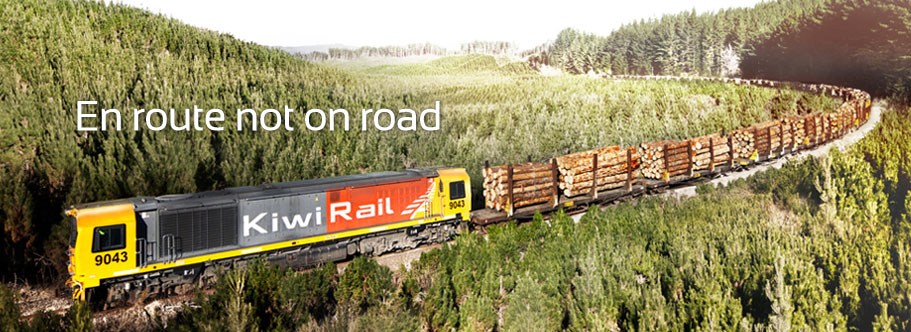
Source: http://www.kiwirailfreight.co.nz/

Again it comes down to a few things:

  1. Lack of a coordinated strategy which again a Planning Ministry like the Australian States have. Such a Planning Ministry would be able to “coordinate” (at this rate coerce) between Kiwi Rail, NZTA, Ports, and Councils. This would allow the creation inter-regional Super Plans like one for the entire Upper North Island that then everyone would have a framework to follow (and make investment between Public and Private sector that much more easier)
  2. Splitting Kiwi Rail into two. The tracks go to NZTA and the freight/passenger side to a separate State Owned Enterprise open to full competition. Heck you could even list 49% on the NZX to which Fonterra, Mainfreight, Port of Tauranga and (yeah I know) Auckland Council via Auckland Council Investment Limited) could take stakes in.
  3. Blind ideology which both Labour and National are at fault of

So with Auckland’s productivity continuing to drop (mainly due to transport) we have two choices and rather simple choices at that:

  1. Continue to forget rail and invest in roads and really watch productivity and environment slip
  2. Invest in rail rather than “highways” (as well as coastal shipping) which our competing cities and economies are doing. If their productivity goes up from this then why are we so slow in following them.