
Imposter Syndrome or Wrong Country?
Either it is blowing smoke up the proverbial, I suffer from a dose of Imposter Syndrome and am selling myself short, or I am in the wrong country with a nation too conservative, entrenched in the status quo, inward looking, and proving Prime Minister Luxon was right in New Zealand being a wet and whiny nation (who loves endless business cases but freaks out doing real work). Those were the three scenarios I was looking at when I got Gemini and Notebook to cast a “glance” over my CV, LinkedIn profile, and both blogs to write an advertisement about well, myself as a Planner in New Zealand.
In the end, I got the LLMs to produce these advertisements about me in two formats: blog post version which was a more relaxed look at my credentials, and the professional version which was more formal and the one I could (but not necessarily would for a too conservative New Zealand audience) use when or rather as I am looking for work. Both the blog and formal versions had the text and AI video renderings done to match the scenario I was looking at. The text and video version you are reading/watching in this blog post is the blog post version. I will post the formal version into the blog later on.
So what are my thoughts of the LLM basically producing a digital CV and Cover Letter in text and video format? Apart from some initial edits for clarity and matching it to New Zealand English (which would still need to happen if it was 100% human written as well by the way) my initial reaction was that the LLM was really blowing smoke up the proverbial. That is it was being rather liberal to the point of hyperbole in the content it produced for me. Then I went away and took another look to which my second and more nuanced reaction was Imposter Syndrome. I am not that bold and provocative am I in Planning and how I both see and want the Planning world to go in New Zealand I thought. I then realised actually given the amount of trouble and bollocks I have landed myself in for being bold and provocative over the last 16 years (which has no doubt cost me employment in New Zealand) the LLM is probably pointing in the right direction. The problem was when the penny finally dropped aka this morning as I came back to this draft is that the LLM was correct in that I do have Imposter Syndrome because how I see things rubs up against the the nation as a whole. In other words inwards, conservative, and prone to being wet and whiny.
And if the reforms and attitudes towards AI are anything to go by, this blog post will again provoke but also illustrate rather starkly that the LLM actually did do a reasonable job creating an advertisement about me, it is just the domestic audience does not match what was produced (the international audience certainly does).
With that, here is the blog version of the LLM producing an advertisement of me as a Planner in slide deck, blog post text, and AI video formats.
NOTE: there is a big caveat in that the LLM in producing this advertisement of me, it has taken my submission to the Planning Bill and extrapolated out how I see Planning and my vision and my belief in where Planning should go in New Zealand.
By the way if my slogan of Planning, Building and Experiencing sounds familiar that is because it is my Cities Skylines 2 moniker.
Ben Ross: Planning, Building, and Experiencing!
1. Introduction: Beyond the RMA—The Rise of the Strategic Planner
New Zealand’s urban landscape is currently undergoing a dramatic decoupling from thirty years of “Grey Inertia.” As the nation transitions from the decentralized, effects-based Resource Management Act (RMA) to the centralized, outcomes-focused architecture of the new Planning Act, the industry faces a critical talent deficit. This era demands a new breed of professional—one who is part legislative architect, part technologist, and part human-experience engineer.
Ben Ross, an Associate NZPI Urban Planner with over 12 years of industry proficiency, is the personification of this shift. Recognized by his peers as a leader who is “Geared for Growth,” Ross offers a unique value proposition: the ability to bridge the gap between rigorous local government policy and the leading-edge technological frontier. By combining high-level legislative reform with advanced spatial simulation, Ross does not just plan cities; he hard-codes them for resilience and economic velocity. To understand Ross is to understand a track record of navigating the front lines of New Zealand’s most significant regulatory upheavals.
2. The Legislative Architect: Leading Reform from the Front Lines
In periods of massive regulatory transition, policy leadership is the ultimate de-risking strategy for an organization. Ross’s tenure as Senior Policy Planner at the Waikato District Council (2023–2026) was defined by this dual-track mastery: settling legacy appeals to make the District Plan “Operative in Part” by 2025, while simultaneously co-leading the organisation’s submission for the Planning Act. Ross would also architect his own comprehensive submission to the Planning Act which was received very well by the Environment Select Committee in Parliament.
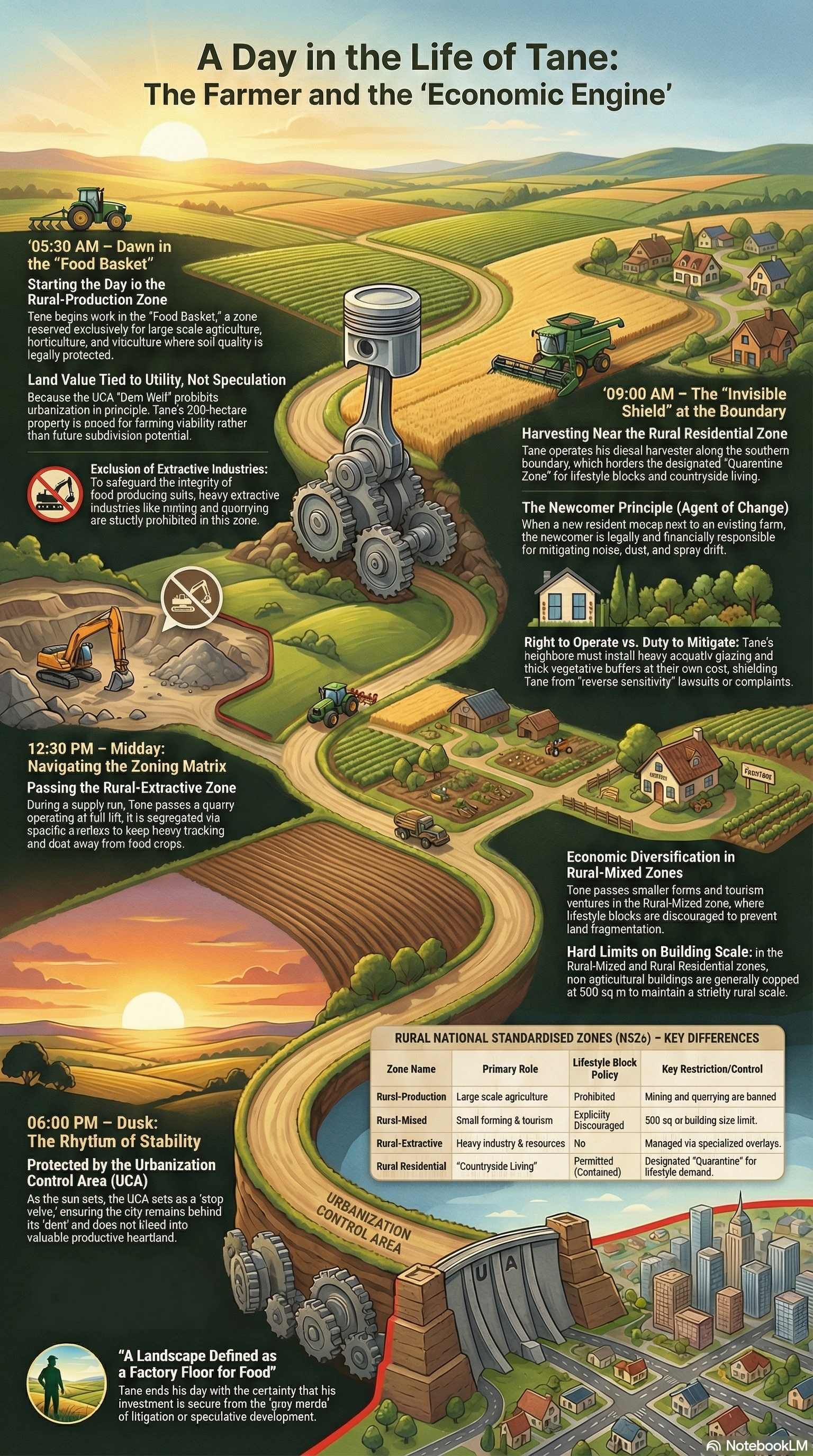
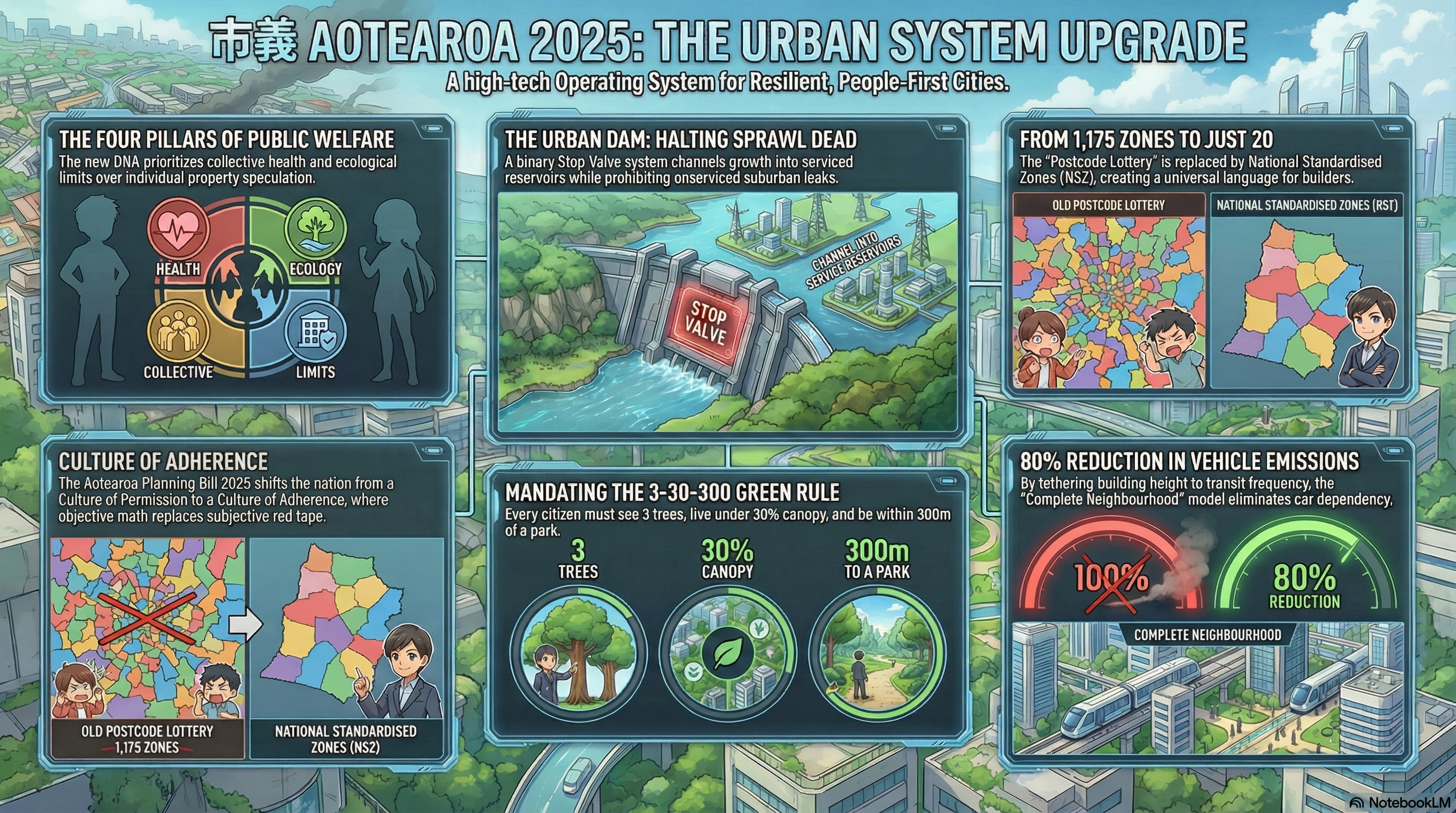
Ross’s philosophy is an “Urban Operating System” upgrade. Drawing from the Japanese 1974 Land Use Planning Act, he advocates for a “Public Welfare Supreme” model. This ideology dictates that collective urban health and functionality take legal precedence over individual property vetoes or subjective “character” reviews. He illustrates this through the “Urban Dam” mechanism:
- The Reservoir (Urbanisation Promoting Area – UPA): Designated growth zones with a 10-year horizon where “Infrastructure First” mandates unlock rapid development.
- The Stop Valve (Urbanisation Control Area – UCA): Zones where urbanization is prohibited in principle, stopping speculative land-banking and sprawl.
As seen in the case of Tane the Farmer, Ross’s framework ensures that productive soil is valued for its yield rather than its potential as “future suburbia,” providing the rural sector with unprecedented economic stability.
3. Engineering Human Experience: Transit and Global Perspectives
Modern infrastructure is the “skeleton” of the city, and transit is its primary artery. Ross approaches transit not as a utility, but through “Human Experience Engineering.” This was demonstrated at Colab and Associates, where he produced wayfinding and infrastructure strategy for high-stakes projects including the North-western Bus Improvements (NWBI), the iREX Interislander ferry replacements, and major Ferry Terminal Redevelopments.
Ross’s perspective is global. As a Lead Trainer for the UITP, he has delivered best practices in “Designing Community Oriented Stations” to international audiences and co-led peer reviews for the Riyadh Metro and NEOM Land Mobility Agency. A key differentiator in his toolkit is the development of Human Recharge Stations (HRS) and Integrated Large Human Recharge Hubs (LHRH). These are not merely bus stops; they are essential post-oil-crisis social infrastructure—incorporating libraries and community facilities—designed to support the “human biological engine.”
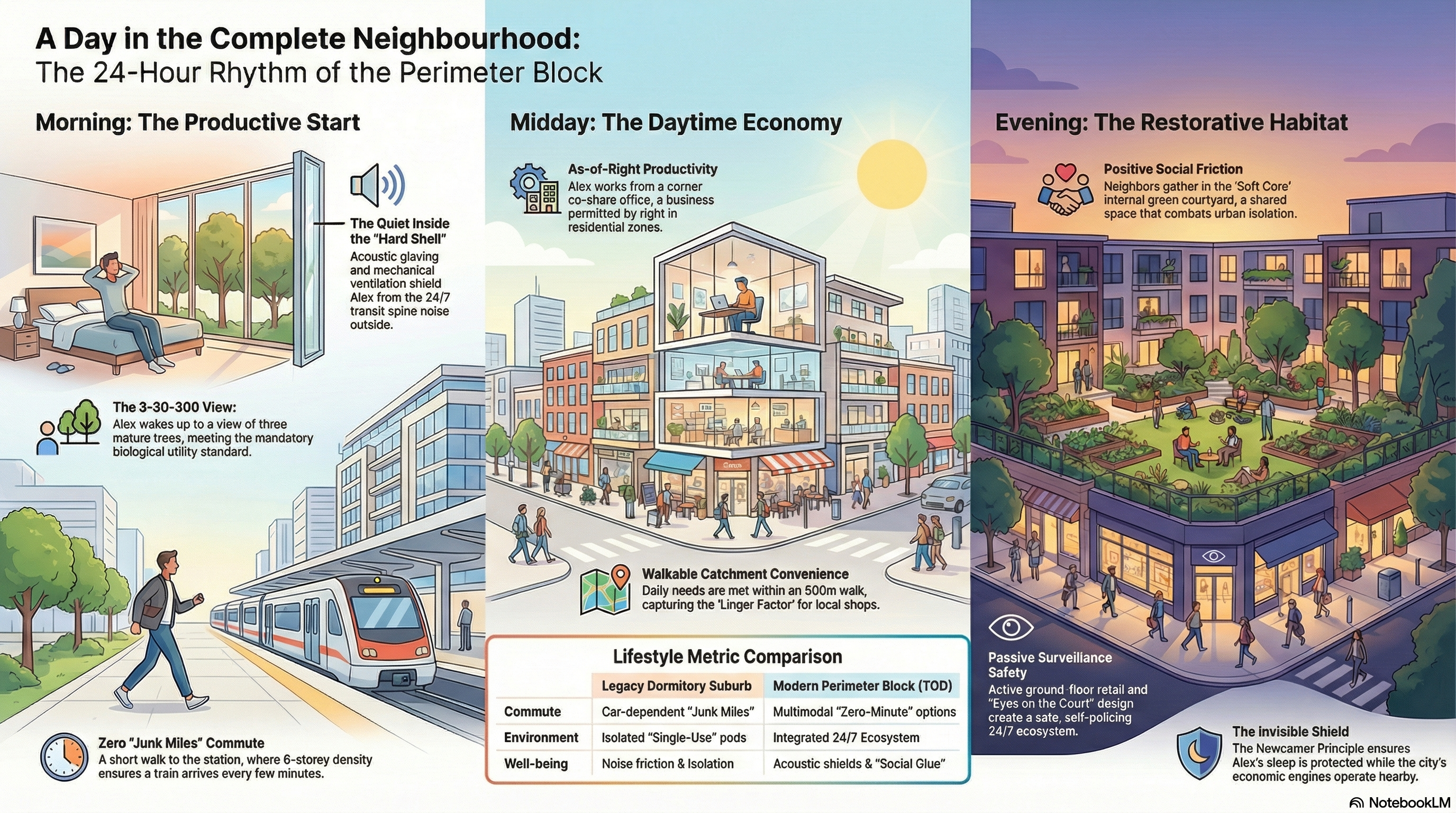
Ross understands the urban “Hard Shell,” as illustrated by Alex’s Town, where high-intensity transit corridors coexist with silent, restorative internal courtyards through advanced acoustic engineering and “Density Follows Frequency” logic.
4. The Tech Pioneer: AI Blueprints and Virtual Urbanism
In a “Geared for Growth” environment, the integration of Artificial Intelligence and spatial simulation is non-negotiable. Ross utilizes these tools designed to bypass “political partisan pontification” and deliver high-fidelity results.
His “Tech Stack” for 21st-century planning includes:
- AI Integration & The KISS Principle: Ross leverages Large Language Models to co-develop blueprints for the Auckland Regional Combined Plan. By utilizing “unapologetic language,” he strips away bureaucratic jargon to deliver a streamlined, user-friendly regime that maintains a high quality of life while accelerating delivery.
- Virtual Simulation: Ross uses Cities: Skylines 1 & 2 as a professional sandbox. In his virtual city, “Waikato,” he tests “Transit by Design” and “Zoning 101” concepts, observing how infrastructure responds as the city scales from 8,000 to 60,000 residents.
- The Russian Doll Model: Influenced by Japanese inclusive zoning, Ross champions “as-of-right” mixed-use development. In Maia’s Neighbourhood, this allows a corner co-share office to thrive in a residential zone, fuelling the daytime economy and creating walkable, 15-minute cities by default.
5. The Scientific Mandate: Hard-Coding Resilience into the Landscape
Ross’s morals and values treats environmental health and industrial protection as non-negotiable utilities. His planning is grounded in mathematical and biological reality, delivering a massive fiscal return.
- The 3-30-300 Rule (The Green Utility): A mandatory standard requiring at least 3 mature trees visible from every window (home, school, or workplace), 30% neighbourhood canopy cover, and an actual 300-meter barrier-free pedestrian walk to high-quality green space.
- Biological Engineering: He mandates “connected soil volumes”—underground trenches that allow root systems to spread beneath pavement. This “Sponge City” layout yields a 1:18 Social ROI, reduces impermeable surfaces by 90%, and cuts infrastructure Capex by up to 50%.
- The Newcomer Principle (Agent of Change): To prevent “reverse sensitivity,” Ross places the duty to mitigate on the newcomer. As demonstrated by Kahu’s industrial habitat, a resident moving near a port or steel plant must fund their own acoustic glazing, securing the incumbent industry’s “Right to Operate.”
6. Suitability Analysis: The Dual-Value Proposition
| For Local Council Planning | For Private Consultancy |
| Growth Management Mastery: Implements the “Urban Dam” (UPA/UCA) to stabilize land prices and force efficient, serviced expansion. | Developer-Friendly Certainty: Advocates for National Standardised Zones (NSZ) and “As-of-Right” Russian Doll zoning to liquidate project-level litigation. |
| Public Welfare Supreme: Prioritizes collective urban health and safety over individual subjective character complaints. | AI Drafting Efficiency: Uses LLMs to generate simplified, “unapologetic” policy blueprints, slashing lead times for complex submissions. |
| Mentorship & Reform: A proven leader in transitioning junior staff through the Planning Act and Natural Environment Act rollouts. | Asset De-risking via Simulation: Uses urban simulators to visualize spatial plans and transit feasibility for stakeholders in high-fidelity 3D. |
| Scientific Resilience: Hard-codes the 3-30-300 rule into plans to achieve a 1:18 Social ROI and 50% infrastructure savings. | TOD Expertise: Leading expert in Transit-Oriented Development and “Human Recharge” infrastructure for high-value PPPs. |
7. Conclusion: Securing the Future of Aotearoa’s Urban Fabric
Ben Ross is more than a planner; he is a strategic navigator for the post-RMA world. By integrating biological utility, legislative rigor, and technological simulation, he transforms urban planning from a reactive hurdle into a proactive engine of growth.
Hiring Ben Ross is a strategic investment in a “Geared for Growth” leadership model. His ability to deliver certainty in a time of reform makes him an indispensable asset for any organization looking to lead the next generation of New Zealand urbanism. We invite you to reach out to discuss how Ross’s “Urban Operating System” can secure your next high-value project.


