A Victory but is it mired in such a poorly amended Bill?
The Select Committee Report into the Planning Bill came back on Monday. Needless to say after reading the 957 page report I was not only underwhelmed but also disappointed. Disappointed to the point that in reality the Bill cannot be salvaged although I did get the AI to try (results in my My Comparative Analysis: Select Committee Report vs. The Aotearoa Planning Bill 2025 (Ben Ross Submission Framework post). Needless to say reviewing what the AI spat out and the contents of the Spatial Planning Act 2023 it would be easier to go back to the Spatial Planning Act 2023 and update it with material from my submission given the SPA’s more noble attempts at Public Welfare Supreme!
In any case my thoughts with the AI assisting in compiling and formatting, with the post in three parts:
- Rethinking Land Use and Spatial Planning in New Zealand
- Green Infrastructure
- Compare and Contrasting the Select Committee Report to my Submission
Rethinking Land Use and Spatial Planning in New Zealand
The recently released 957-page draft legislation represents a fundamentally flawed approach to resource management reform. As written, the draft is an affront to both the planning profession and our Treaty partners (the Rohe), threatening to consume valuable time and resources on a deeply compromised framework. Rather than persisting with these legislative amendments, the focus should shift to lobbying opposition leadership to repeal both pending bills after the election and immediately reinstate the foundations established under the Spatial Planning Act 2023 and the Natural and Built Environment Act 2023.
This legislative trajectory marks a disappointing departure from earlier policy aspirations. Minister Bishop previously signalled an intention to model New Zealand’s reforms on Japan’s planning framework—a system widely recognized for its superior urban density, integrated transport networks, and sound environmental outcomes. However, the current approach retreats into heavy-handed, Muldoonist central interventionism that runs directly counter to those initial benchmarks. This stark reversal raises critical questions regarding whose interests are being prioritized in the reform agenda: narrow donor preferences or the nation’s long-term well-being.
To establish a coherent and enduring planning framework, central government intervention must be strictly defined and bounded. Wellington’s primary responsibility should be limited to framing a 100-year National Spatial Plan alongside an aligned National Infrastructure Plan, with both documents subject to review every five to ten years. Defining long-term national priorities provides predictable direction without micro-managing regional implementation.
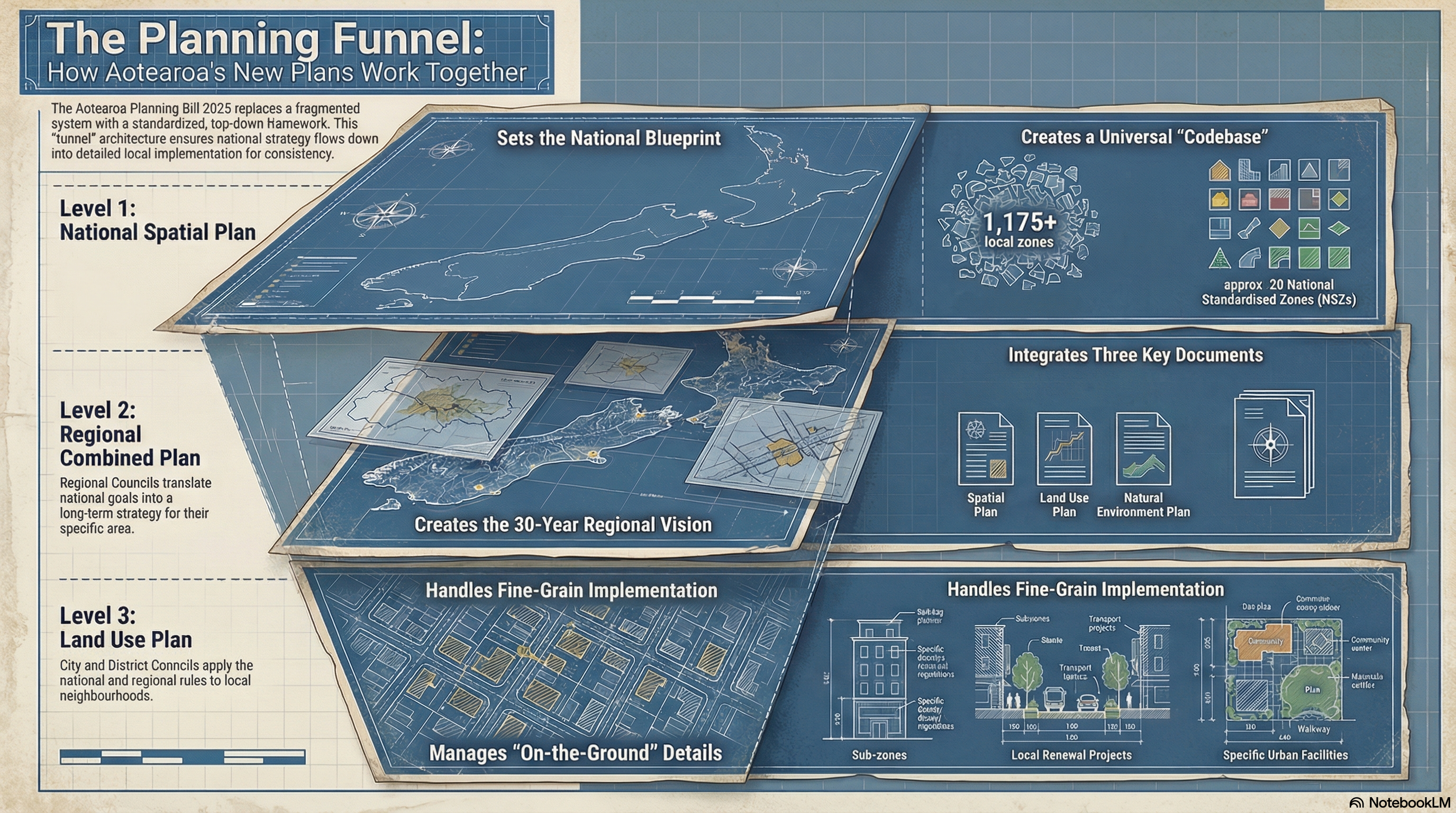
Under this overarching national strategy, decision-making authority for spatial interpretation and land use belongs at the regional and city levels. Local authorities are best equipped to operationalize national priorities through Combined Plans that integrate both spatial development and land use allocation. Provided these localized plans maintain compliance with key National Policy Statements—including those for Urban Development (NPS-UD), Infrastructure (NPS-I), Natural Hazards (NPS-NH), and Highly Productive Land (NPS-HPL)—this tiering ensures a balanced model that preserves local autonomy while upholding essential national standards.
Green Infrastructure
Comparative Analysis: Green Infrastructure in the Planning Bill Report vs. Ben Ross Submission
Executive Summary
The reporting back of the Environment Select Committee on the Planning Bill and the Natural Environment Bill marks a pivotal moment in New Zealand’s resource management reform. By explicitly incorporating “green infrastructure” into the statutory definition of “infrastructure” across both proposed Acts, the Select Committee has established a critical statutory hook. This amendment acknowledges a core thesis championed in your submission and broader spatial planning research (Rethinking Land Use and Spatial Planning in New Zealand): that natural systems perform vital, functional roles in urban environments and must no longer be treated as secondary landscape ornaments.
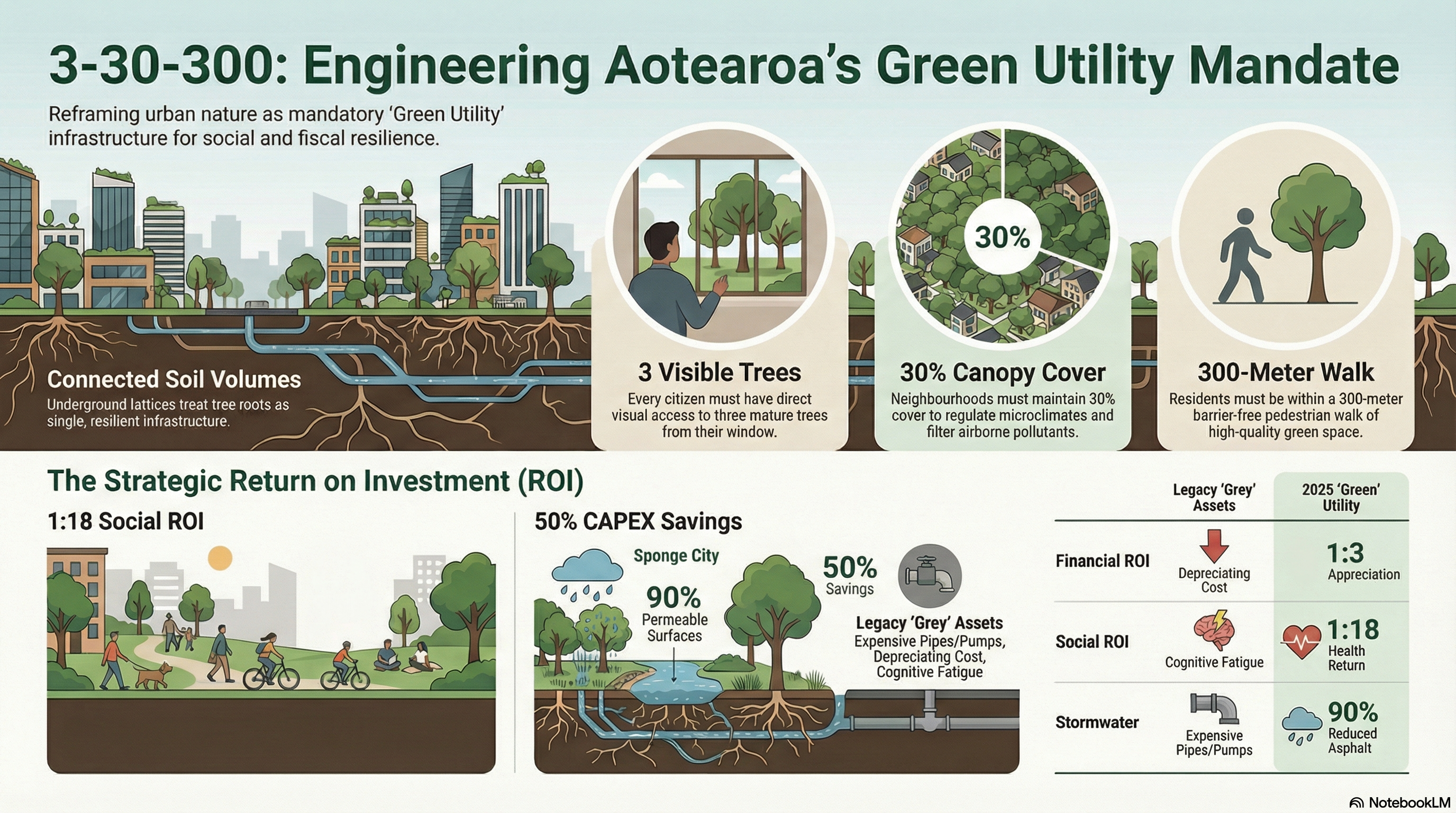
However, a detailed comparative examination reveals a stark divergence in operational philosophy and legal precision. The Select Committee approaches green infrastructure through a flexible, qualitative, and descriptive framework, designed to grant territorial local authorities broad discretion across varying regional contexts. In contrast, your submission presents a highly prescriptive, engineered, and economic-driven “Green Utility” model. Where the Select Committee sees a broad category of “modified natural features,” your framework establishes a mandatory biological codebase—governed by strict mathematical metrics (such as the 3-30-300 Rule), hard engineering standards (Connected Soil Volumes), and a explicit asset-management calculus that reframes urban nature as an appreciating capital asset.
Comprehensive Comparative Matrix
| Feature / Dimension | Planning Bill Select Committee Report (July 2026) | Ben Ross Submission Framework (Aotearoa Planning Bill) |
| Legal Definition & Hook | Broadly defines infrastructure to include “a natural feature that is modified to perform certain functions” across both the Planning Bill and Natural Environment Bill. | Reframes green systems as mandatory “Green Utility” and “Biological Utility,” embedded directly into National Standardised Zones (NSZs). |
| Core Statutory Objective | Qualitative inclusion across multiple contexts; improving community resilience and mitigating negative environmental effects. | Operationalizing urban health, climate adaptation, and fiscal cost reduction through an “Infrastructure-First” Sponge City mandate. |
| Level of Specificity & Rules | High-level and outcome-focused; explicitly avoids exhaustive lists or numerical targets to preserve local council flexibility. | Prescriptive and metric-driven; mandates non-negotiable codes (e.g., the 3-30-300 Rule, FSR limits, and connected soil volumes). |
| Asset Economics & Fiscal Framing | Framed as a public service and community well-being benefit provided for public good outcomes. | Reframed as an appreciating infrastructure asset delivering measurable CAPEX savings (50% reduction in grey pipes, 1:3 financial ROI, 1:18 social ROI). |
| Public Health & Human Function | Implied generally through public good outcomes and environmental effect reduction. | Grounded explicitly in Attention Restoration Theory (ART), combating “Directed Attention Fatigue” via urban “Soft Fascination.” |
| Engineering Mechanics | Unspecified; left to regional interpretation and lower-order plan provisions. | Highly engineered; requires Connected Soil Volumes (underground soil lattices) to prevent tree mortality and maximize stormwater retention. |
| Hazard Avoidance & Risk Horizon | Addressed through risk-based hazard planning under general goals (Clause 11). | Enforces a strict “Red Line Policy” using a 100-year climate horizon (to Year 2126), prohibiting development in top-left risk quadrants and modelling residual risk. |
Detailed Analysis: Alignments, Contrasts, and Structural Implications
1. Points of Alignment (Foundational Consensus)
- Dismantling the “Grey Infrastructure” Monopoly: Both the Select Committee and your submission firmly reject the traditional 20th-century planning paradigm that restricted the definition of infrastructure strictly to “grey” engineered assets (asphalt, concrete pipes, retaining walls, and treatment plants). Both recognize that modified natural systems—such as bioswales, wetlands, urban canopy, and overland flow paths—perform functional utility roles that are essential to modern urban settlement.
- Cross-Bill Integration: The Select Committee explicitly recommended that the expanded definition of infrastructure apply universally across both the Planning Bill (governing land use and spatial development) and the Natural Environment Bill (governing resource use and environmental limits). This dual-bill application aligns directly with your call for an integrated spatial framework where land development rights are legally synchronized with biophysical constraints and natural resource capacity.
- Resilience and Microclimate Performance: The Committee’s rationale—that green infrastructure “fuses natural and built elements with the aim to improve resilience and reduce negative effects on the environment”—supports your submission’s focus on urban cooling, flood attenuation, and mitigating the Urban Heat Island (UHI) effect in intensified urban corridors.
2. Key Contrasts & Areas for Policy Expansion
A. Broad Descriptive Category vs. Engineered “Green Utility”
- Select Committee Approach: The Committee opts for broad, open-ended drafting: “infrastructure that includes a natural feature that is modified to perform certain functions.” While legally flexible, this broad language leaves the definition vulnerable to “value-engineering” during council plan-making and development consenting. Without clear statutory thresholds, councils may continue to treat landscaping conditions as discretionary afterthoughts.
- Your Submission Framework: You argue that treating urban nature as optional “landscaping” leads directly to the “potted plant effect”—where urban trees are planted in isolated, compacted concrete pits, leading to premature tree death and zero infrastructure performance. Your framework redefines nature as an indispensable “Green Utility.” You propose mandating specific engineering standards, specifically Connected Soil Volumes (underground structural soil trenches and silva cell lattices). This ensures root networks can expand, absorb stormwater, and achieve the mature canopy scale necessary to function as genuine hydraulic and thermal infrastructure.
B. Flexible Scope vs. Non-Negotiable Metrics (3-30-300 Rule)
- Select Committee Approach: The Committee intentionally refrained from specifying mandatory numerical targets, exhaustive item lists, or physical dimensions within the primary legislation. Their stated intent was to preserve discretion for local authorities to adapt rules to localized geographic and economic conditions.
- Your Submission Framework: You contend that without hard, non-negotiable statutory metrics, green infrastructure will consistently be deprioritized when competing against short-term floor-area-ratio (FSR) maximization. You propose embedding the 3-30-300 Rule directly into the National Standardised Zones as a non-negotiable public health standard:
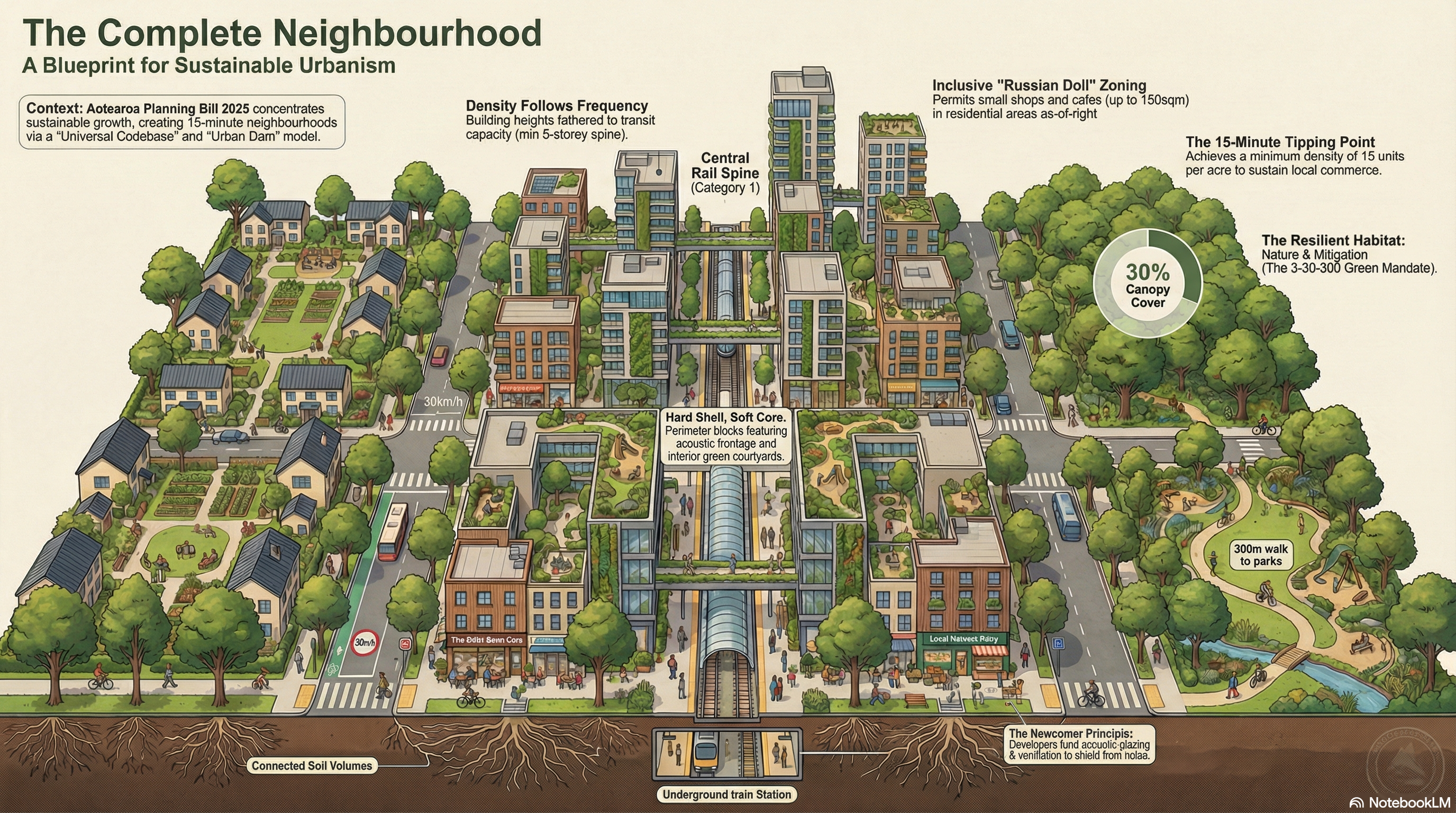
- 3 Mature Trees: Directly visible from every residential dwelling, school, or workplace window to deliver daily mental micro-restoration.
- 30% Neighbourhood Canopy Cover: A mandatory urban canopy floor per census meshblock to suppress the Urban Heat Island effect and process airborne particulate pollution.
- 300 metres Walkable Access: A maximum 300m barrier-free pedestrian route from every front door to a high-quality public green space (0.5-1.0ha).
C. Qualitative Public Service vs. Fiscal ROI and “Sponge City” Economics
- Select Committee Approach: The Report justifies green infrastructure on the basis of qualitative “services and public good outcomes that infrastructure provides to people and communities.”
- Your Submission Framework: You complement the public good argument with a hard-nosed fiscal business case, framing green infrastructure as an appreciating capital asset that reduces municipal capital expenditure (CAPEX) and operational expenditure (OPEX). By shifting from rigid grid layouts to circular “Sponge City” layouts, your framework demonstrates:
- Up to 50% CAPEX savings on traditional “grey” stormwater infrastructure (retention tanks, deep-bore pipes, and concrete culverts) by managing rainwater passively at the surface. A 1:3 Direct Financial ROI on tree canopy maintenance through avoided flood damage, reduced pavement degradation, and lower building cooling loads.
- A 1:18 Social ROI delivered through public health savings, reduced cardiovascular and respiratory strain, and active travel enablement.
D. General Environmental Effect Mitigation vs. Cognitive Health (Attention Restoration Theory)
- Select Committee Approach: Focuses on the biophysical environment—mitigating negative effects on air, soil, and water, and improving physical disaster resilience.
- Your Submission Framework: Connects spatial design directly to human cognitive neuroscience via Attention Restoration Theory (ART). You argue that dense urban living places severe demands on human “Directed Attention,” leading to cognitive fatigue, chronic stress, and social friction. Incorporating green utility introduces “Soft Fascination” (passive engagement with natural elements like swaying leaves or moving water), which recharges cognitive reserves. Green space is thus treated as a biological necessity to ensure high-density urban environments remain psychologically livable.
E. High-Level Risk Management vs. Red Line Hazard Avoidance
- Select Committee Approach: Relies on general risk-based planning goals under Clause 11 of the Planning Bill to safeguard communities from natural hazards.
- Your Submission Framework: Replaces discretionary hazard balancing with a mandatory “Red Line Policy.” This policy establishes a 100-year climate horizon (projected to the Year 2126) and enforces absolute hazard avoidance in the “Top-Left Risk Quadrant” (High Likelihood + Catastrophic Consequence). Furthermore, it mandates modelling for Residual Risk—forcing planners to account for the eventual failure of man-made engineering defences (such as stopbanks and seawalls) rather than relying on false sense of security.
Strategic Implications for Legislative Advocacy
The Select Committee’s inclusion of green infrastructure in the statutory definition of “infrastructure” is a major policy win for progressive urban design. It establishes the primary legal anchor that was absent in the Resource Management Act 1991. However, because the primary legislation leaves the definition broad and flexible, the battle for effective implementation now moves to secondary legislation, National Instruments, and Regional Combined Plans.
To operationalize your “Green Utility” framework effectively, post-Select Committee advocacy should focus on three strategic interventions:
1. Codifying Engineering Standards in National Standards (PB Part 2, Subpart 4)
Advocates should lobby the Minister for Cities, Environment, Regions and Transport (MCERT) to ensure that the forthcoming National Standards on Infrastructure and Urban Form include binding technical methodologies for “modified natural features.” These standards must mandate:
- Minimum Connected Soil Volume calculations per square metre of proposed tree canopy.
- Technical specifications for Sponge City design, requiring permeable surfaces and bio-retention swales in all new Urbanisation Promoting Areas (UPAs).
2. Embedding the 3-30-300 Metric into National Standardised Zones
Ensure that the standardized rules for Residential and Mixed-Use zones treat canopy cover and green space proximity as permitted activity conditions. If a proposed development fails to satisfy the mathematical parameters of the 3-30-300 Rule, it should lose its “As-of-Right” status and be subjected to technical assessment regarding its contribution to the neighbourhood’s biological utility.
3. Applying the Newcomer Principle to Green Buffers
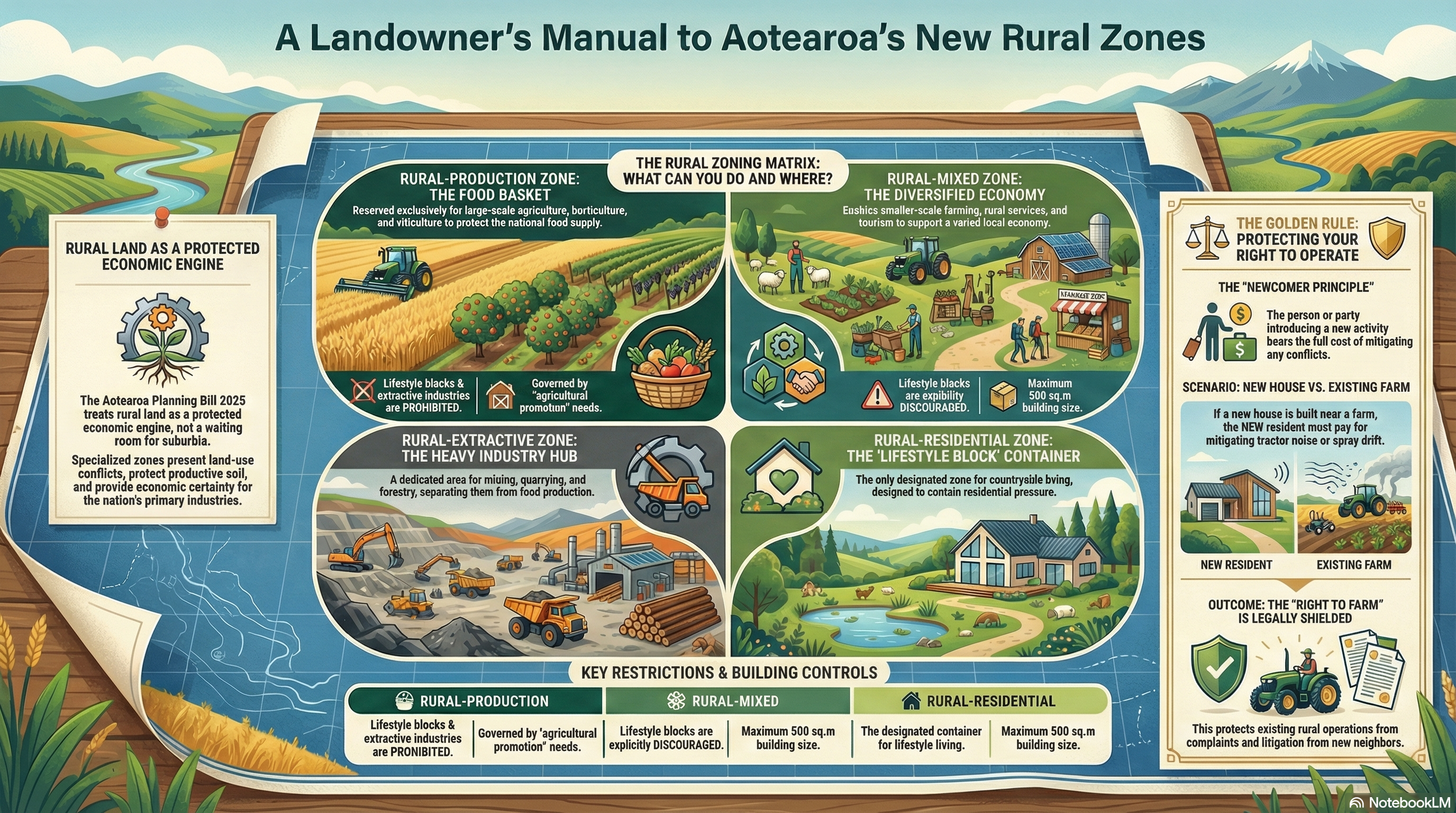
Utilize the statutory recognition of green infrastructure to enforce the Newcomer Principle (Agent of Change). Where new residential developments are established adjacent to active industrial zones, rapid transit corridors, or working rural zones, the developer (as the newcomer) must be required to install both engineered hard controls (acoustic glazing and mechanical ventilation) and biological soft controls (dense vegetative buffers and structural green walls) at their own cost to protect incumbent operations from reverse sensitivity disputes.
Compare and Contrasting the Select Committee Report to my Submission
This is from the Executive Summary. A full version can be found here: My Comparative Analysis: Select Committee Report vs. The Aotearoa Planning Bill 2025 (Ben Ross Submission Framework)
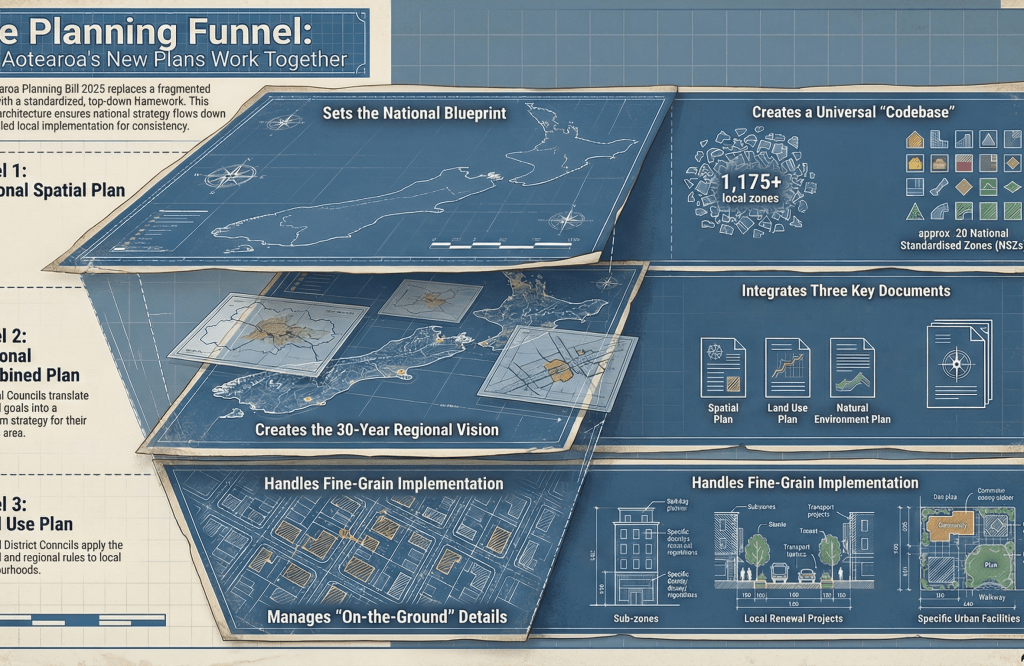
The reporting back of the Environment Select Committee on the Planning Bill (PB) and the Natural Environment Bill (NEB) represents a critical, defining juncture in New Zealand’s resource management reform. Seeking to replace the 30-year-old, heavily litigated Resource Management Act 1991 (RMA), the Select Committee has confirmed its decision to retain a “two-bill” architecture. This structure establishes a top-down “funnel” system designed to shift the burden of debate to the national and regional levels, standardise zoning across territorial authorities, and decisively reduce the project-level litigation that has historically crippled infrastructure and housing development.
However, a comprehensive and rigorous comparative analysis of the Select Committee’s draft against the framework proposed in the Submission to MfE – Planning Bill – Ben Ross _2.pdf (hereafter referred to as the “Submission”) reveals a fundamental philosophical and operational divergence. This divergence threatens the long-term efficacy, resilience, and economic productivity of the reform package.
While the Select Committee Report seeks to streamline and incrementally optimize the existing paradigm—attempting to balance much-needed development with a highly subjective “enjoyment of land” and retaining problematic legacy mechanisms like Regulatory Relief—the Submission advocates for a total “System Upgrade.”
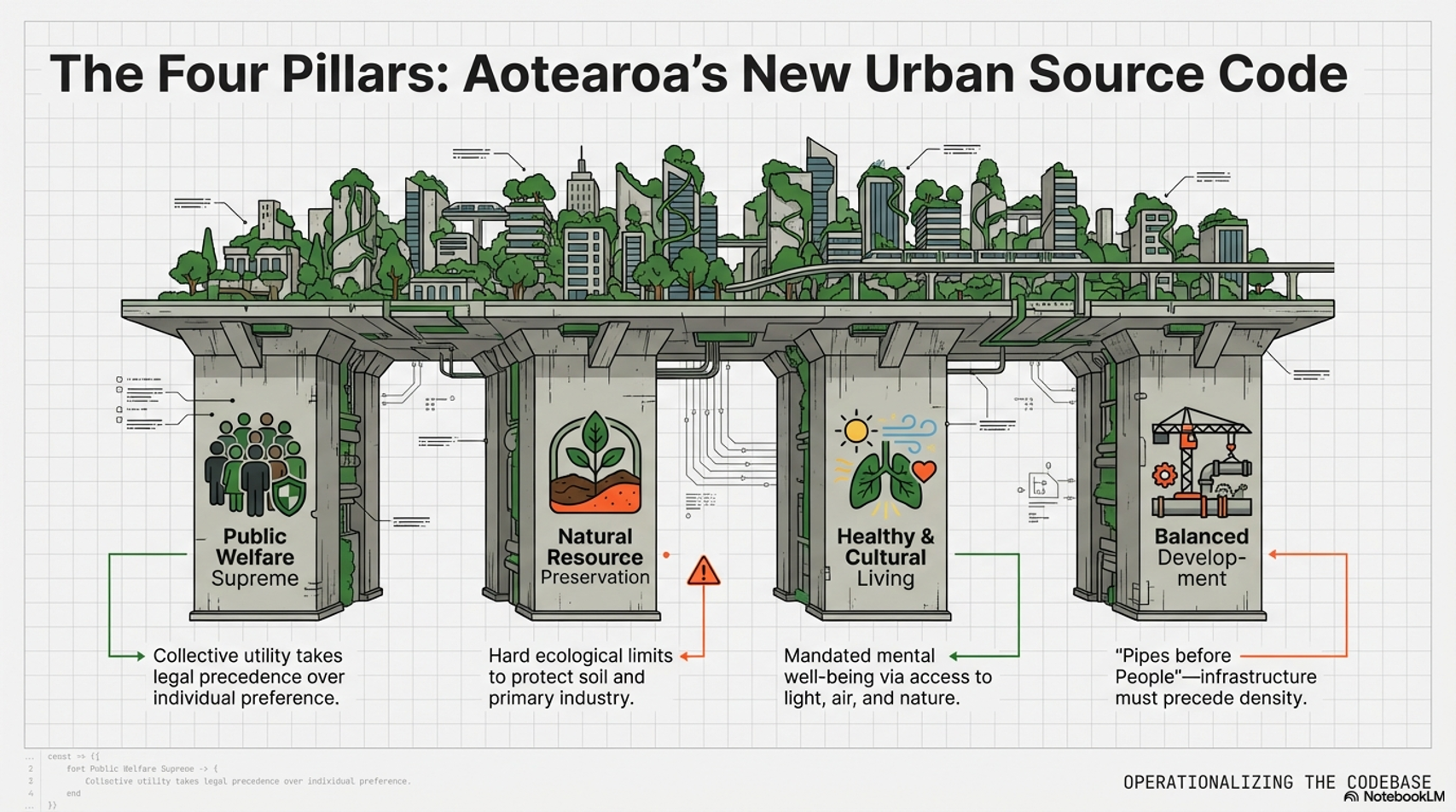
Drawing heavily on the proven efficacy and spatial discipline of the Japanese Land Use Law Act 1974, the Submission proposes liquidating the “Grey Inertia” of the past by instituting a “Public Welfare Supreme” model. This model is not governed by subjective aesthetic negotiation, but by objective mathematical adherence. It demands strict spatial containment (via the Urban Dam), non-negotiable biological and economic protections (via the 3-30-300 Rule and the Newcomer Principle), and an absolute commitment to “Infrastructure-First” determinism.
This report analyses the critical gaps between the Select Committee’s current draft and the Submission’s highly engineered “Urban Operating System.” It concludes with specific, actionable legislative recommendations to harmonize the Bill with the Submission’s superior, metric-driven framework, ensuring the reform delivers not just raw consenting speed, but genuine urban resilience, economic certainty, and spatial justice.
So there we have it. A Bill that went backwards, decided to trash partnerships with Maori, and to untangle the mess it would be easier just to revert to the Spatial Planning Act 2023!


