How did the Select Committee Report into the Planning Bill compare with my submission to said Planning Bill?
After my initial thoughts on the Select Committee report to the Planning Bill, I decided to let the AI have a go in doing a compare and contrast on the amended Bill verses my own submission. Needless to say the AI was not overly thrilled with what is proposed in the Select Committee report either especially around “enjoyment of land.” The AI has also taken recommendations from my submission and generated a report of them in this blog post. Needless to say the Planning Bill in its now amended form from the Select Committee is not exactly worth salvaging and it would be easier to revert back to the Spatial Planning Act 2023 and work back from there.
Any case here is the compare, contrast and recommendations of the Planning Bill verses my own submission.
The Analysis and Recommendations
Executive Summary
The reporting back of the Environment Select Committee on the Planning Bill (PB) and the Natural Environment Bill (NEB) represents a critical, defining juncture in New Zealand’s resource management reform. Seeking to replace the 30-year-old, heavily litigated Resource Management Act 1991 (RMA), the Select Committee has confirmed its decision to retain a “two-bill” architecture. This structure establishes a top-down “funnel” system designed to shift the burden of debate to the national and regional levels, standardise zoning across territorial authorities, and decisively reduce the project-level litigation that has historically crippled infrastructure and housing development.
However, a comprehensive and rigorous comparative analysis of the Select Committee’s draft against the framework proposed in the Submission to MfE – Planning Bill (hereafter referred to as the “Submission”) reveals a fundamental philosophical and operational divergence. This divergence threatens the long-term efficacy, resilience, and economic productivity of the reform package.
While the Select Committee Report seeks to streamline and incrementally optimize the existing paradigm—attempting to balance much-needed development with a highly subjective “enjoyment of land” and retaining problematic legacy mechanisms like Regulatory Relief—the Submission advocates for a total “System Upgrade.”
Drawing heavily on the proven efficacy and spatial discipline of the Japanese Land Use Law Act 1974, the Submission proposes liquidating the “Grey Inertia” of the past by instituting a “Public Welfare Supreme” model. This model is not governed by subjective aesthetic negotiation, but by objective mathematical adherence. It demands strict spatial containment (via the Urban Dam), non-negotiable biological and economic protections (via the 3-30-300 Rule and the Newcomer Principle), and an absolute commitment to “Infrastructure-First” determinism.
This report analyses the critical gaps between the Select Committee’s current draft and the Submission’s highly engineered “Urban Operating System.” It concludes with specific, actionable legislative recommendations to harmonize the Bill with the Submission’s superior, metric-driven framework, ensuring the reform delivers not just raw consenting speed, but genuine urban resilience, economic certainty, and spatial justice.
Part 1: Philosophical Foundations and the Purpose of the Act
The Select Committee Approach: “Enjoyment of Land”
In its review of PB Clause 4 (Purpose), the Select Committee amended the primary purpose statement to read: “to provide for the enjoyment of land by establishing a framework for planning and regulating the use and development of land.”
The Committee acknowledged significant concerns raised by multiple submitters and independent advisors (including the Parliamentary Commissioner for the Environment, who warned of unintended consequences) that “enjoyment of land” is highly subjective and ideologically loaded. However, the Committee chose to retain it. This decision indicates a lingering, deep-seated adherence to a “Property Rights Supreme” philosophy, prioritizing the individual landowner’s preferences over the broader needs of the urban ecosystem.
The Submission Approach: “Public Welfare Supreme”
The Submission diametrically opposes this foundational premise. It argues that legacy systems like the RMA failed precisely because they allowed subjective individual preferences—a phenomenon termed the “Nitpicking Trap”—to override collective needs. The Submission champions the Public Welfare Supreme principle: the collective health, safety, and functional utility of the city must take absolute, unquestionable legal precedence over individual speculative interests or subjective aesthetic “enjoyment.”
Under this model, the “collective good” is defined by mandatory pillars: public health, safety (hazard avoidance), economic resilience (protecting industry), and balanced, infrastructure-led development.
Analysis and Implications
By embedding “enjoyment of land” into the primary purpose clause, the Select Committee leaves the statutory door wide open for exactly the type of NIMBY-driven, subjective litigation the reform aims to stop.
“Enjoyment” is legally nebulous and inherently contradictory in an urban setting; what constitutes enjoyment for one property owner (e.g., an unobstructed view over a low-density, car-dependent suburb) directly conflicts with the enjoyment of another (e.g., living in a dense, walkable, transit-adjacent apartment block). If “enjoyment” remains the overarching purpose of the Act, wealthy incumbents will continue to weaponize the planning system against density and necessary public infrastructure, paralyzing the “funnel” system from the top down.
The Submission correctly identifies that true urban resilience requires the statutory courage to subordinate private aesthetic preferences to public infrastructure needs. If the purpose of the Act is flawed, the entire “funnel” is compromised.
Part 2: Spatial Strategy and Urban Containment
The Select Committee Approach: The Regional “Funnel”
The Select Committee endorses the creation of Regional Spatial Plans (RSPs) with a minimum 30-year horizon (PB Schedule 2) to dictate the gross pattern of urban development. It relies heavily on the “funnel” approach to ensure that lower-order Land Use Plans implement these high-level spatial strategies.
However, the Report stops short of mandating hard, impassable urban boundaries or legally linking zoning exclusively to infrastructure readiness. The boundary between urban and rural environments remains porous, subject to ongoing debate, local political pressure, and negotiation.
The Submission Approach: The “Urban Dam” and “Hydraulic City”
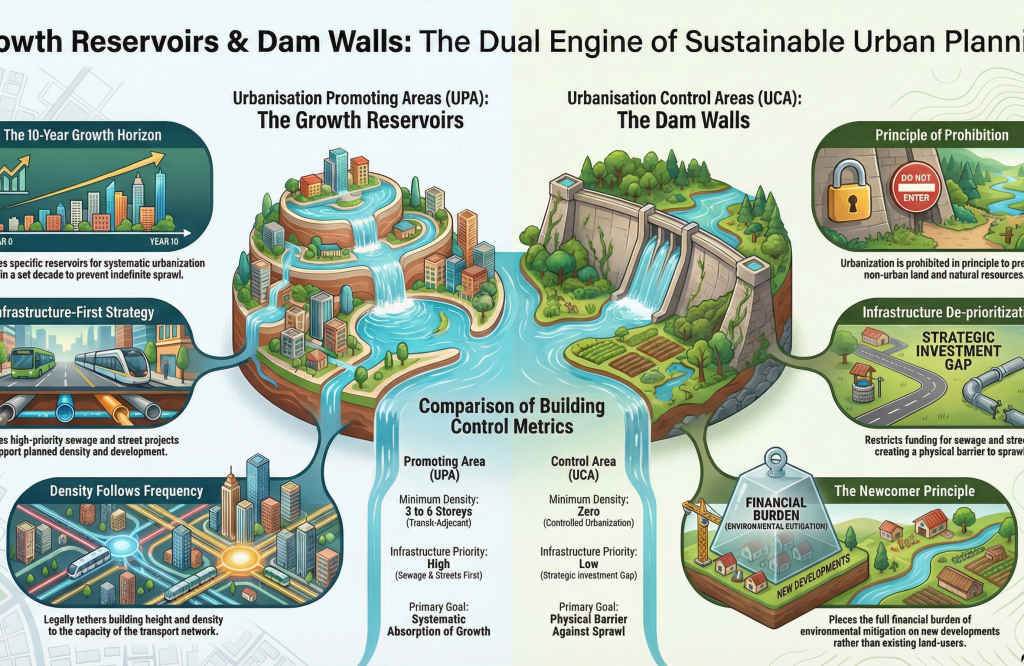
The Submission conceptualizes urban growth through the physical metaphor of the “Hydraulic City.” To prevent the economic pressure of rising land values from “leaking” into unserviced rural sprawl, it mandates a rigid, binary Urban Dam system. This system forces growth upward into high-capacity nodes rather than outward into unserviced, car-dependent fringes.
This binary system consists of two distinct legal states:
- Urbanisation Promoting Areas (UPAs) – The Reservoir: A strict 10-year growth horizon where the state legally prioritizes and guarantees infrastructure. This operates on a strict “Pipes before People” mandate; density is unlocked only when the public skeleton (sewage, streets, transit) is funded and built.
- Urbanisation Control Areas (UCAs) – The Stop Valve: Outside the UPA, urbanization is “Prohibited in Principle.” Infrastructure investment is intentionally and legally starved to function as a “dam wall,” effectively killing speculative land-banking and protecting the “Engine of the Soil” (productive rural land).
Analysis and Implications
The Select Committee’s 30-year spatial plans, while a structural improvement over the fragmented RMA, are too loose and long-term to effectively kill land speculation at the fringe.
Without the rigid, binary UPA/UCA switch and the strict 10-year infrastructure lock proposed in the Submission, cities will continue to suffer from “Regulatory Debt”—the compounding, multi-generational fiscal liability of servicing unplanned, leapfrog sprawl with new roads and pipes. The Submission’s approach recognizes that sprawl is a failure of containment. The UCA acts as the necessary “dam wall” to ensure the UPA “reservoir” functions efficiently, forcing capital back into the urban core to make vertical density and rapid transit economically viable.
Part 3: Zoning, Density, and the Urban Form
The Select Committee Approach: Standardisation with Discretion
The Report supports the significant step of replacing 1,175+ fragmented local zones with a universal codebase of National Standardised Zones (PB Clauses 58-60).
Crucially, it also takes a vital step in narrowing out-of-scope effects via the Section 14 Mandate. The Committee explicitly demands that decision-makers disregard “the character, appearance, and aesthetic qualities” of a building, as well as the “type of residents” to be housed. This is a crucial move to speed up consenting, reduce friction, and move away from discretionary “character” reviews.
The Submission Approach: “Density Follows Frequency” and Inclusive Zoning
The Submission applauds the move to National Standardised Zones and the narrowing of Clause 14, viewing them as necessary steps toward a “Culture of Adherence” (where compliance with math guarantees a permit). However, it insists on injecting rigid Japanese operational logic into these zones to ensure they deliver actual density:
- Density Follows Frequency (Infrastructure Determinism): A strict legal tether between minimum building height and public transit capacity. Category 1 (Rapid Transit Spines) must have a mandatory 6-storey minimum using “Hard Shell / Soft Core” block designs. Category 2 (Frequent Bus) must have a 3-storey minimum and a 30km/h speed limit.
- Inclusive (Russian Doll) Zoning: Eradicating the Western legacy of single-use pods. Narrow-range commercial activities (cafes, shared offices, dairies up to 150m2 must be permitted as-of-right in all low-rise residential zones to activate the 15-minute city Daytime Economy by default.
- Mathematical Adherence: Consenting must move entirely from subjective negotiation to purely objective adherence—based strictly on Floor-Space Ratio (FSR), Building Coverage Ratio (BCR), and sunlight planes.
Analysis and Implications
The Select Committee’s narrowing of out-of-scope effects in Clause 14 is a massive, necessary step toward the Submission’s vision. However, the Bill currently lacks the statutory courage to mandate minimum densities tied to transit investment.
Without enforcing “Density Follows Frequency” at the national level, local councils can still zone for low-density housing around billion-dollar rail lines, stranding the assets and failing to capitalize on the infrastructure. Furthermore, true mixed-use vitality requires the “Russian Doll” inclusive zoning model. This legalizes the “15-minute city” by default, rather than treating a corner cafe or a co-share office as an anomaly requiring special, expensive consent.
Part 4: Environmental Health and Hazard Avoidance
The Select Committee Approach: Flexible Limits and Accommodations
- Hazards: The Report amends PB Clause 146 to allow consent refusal based on “significant risk from natural hazards.” However, it provides broad, concerning exclusions for primary production and infrastructure.
- Climate Change: The Committee explicitly excluded the consideration of adverse greenhouse gas emissions from both the PB and NEB (New Clause 15A), leaving it entirely to other legislation (like the ETS).
- Environmental Limits: Under the NEB, the framework allows the Minister to create national standards that authorise activities to breach environmental limits (NEB Clause 79), introducing significant flexibility into what should be hard bottom lines.
The Submission Approach: Non-Negotiable Mandates
- The Red Line Policy: The Submission demands absolute, mandatory hazard avoidance using a 100-year climate horizon (projecting to Year 2126). Development in the “Top-Left Risk Quadrant” (High Likelihood + Catastrophic Consequence) must be “Prohibited in Principle.” Crucially, it demands modelling for Residual Risk (the inevitable failure of man-made seawalls/pumps), refusing to rely on depreciating grey infrastructure.
- The 3-30-300 Rule (Green Utility): Nature is treated as mandatory biological infrastructure, not an aesthetic nicety. The Submission requires 3 visible trees per home, 30% canopy cover (via engineered Connected Soil Volumes), and a 300m walk to parks to combat cognitive fatigue and manage stormwater.
Analysis and Implications
The Select Committee’s approach to environmental limits and hazards contains fatal loopholes. Allowing national standards to authorise the breaching of ecosystem limits (NEB Clause 79) undermines the entire concept of an environmental “bottom line,” as noted by the PCE. The exclusions for infrastructure in hazard zones under PB Clause 146 risk creating stranded assets built in harm’s way.
Furthermore, treating green space as a nice-to-have rather than a mandatory “Biological Utility” ignores the massive CAPEX savings (up to a 50% reduction in grey pipes via Sponge City design) and the 1:18 social ROI on public health detailed in the Submission.
Part 5: Managing Friction and the “Regulatory Relief” Crisis
The Select Committee Approach: Regulatory Relief
The Report retains the highly controversial and financially dangerous Regulatory Relief mechanism (PB Schedule 3, Part 4). If a council rule regarding a “specified topic” (e.g., significant natural areas, heritage, terrestrial biodiversity) has a “significant adverse impact” on the reasonable use of private land, the council may be forced to provide relief (monetary compensation, extra development rights, etc.).
The Submission Approach: The Newcomer Principle
The Submission explicitly and forcefully rejects the premise of Regulatory Relief. It argues that the public must never be forced to pay private owners to protect the collective habitat or natural heritage. Instead, the Submission manages urban friction via the Newcomer Principle (Agent of Change).
- The Mechanism: If a developer (the newcomer) builds apartments next to a 24/7 port, an active rail corridor, or a working farm (the Economic Engine), the developer is legally mandated to bear $100\%$ of the cost for acoustic glazing, mechanical ventilation, and vegetative buffers.
- The Outcome: The incumbent’s “Right to Operate” is shielded from reverse sensitivity litigation, and the new residents are guaranteed a safe, quiet indoor environment (the “Invisible Shield”).
Analysis and Implications
The Select Committee’s retention of Regulatory Relief represents a massive, unquantifiable fiscal liability for local councils (estimated up to $1.99 billion). This will create a severe “chilling effect,” incentivizing councils to abandon environmental, biodiversity, and heritage protections to avoid bankrupting themselves paying out compensation claims. It directly contradicts the Submission’s “Public Welfare Supreme” ethos.
The PB must abandon Regulatory Relief entirely. Instead, to manage the genuine friction of intensification, it must adopt the Newcomer Principle. This clearly establishes liability at the interface of different zones, protecting the nation’s economic engines without public subsidy.
Recommendations for Amending the Planning Bill
To bring the Select Committee’s version of the Planning Bill into alignment with the Submission’s high-performance, resilient framework, the following amendments must be aggressively pursued during the Second Reading or Committee of the Whole House stages:
1. Amend the Purpose and Goals (Clauses 4 & 11)
- PB Clause 4: Delete the phrase “to provide for the enjoyment of land”. Replace it with: “The purpose of this Act is to establish a framework for planning and regulating the use and development of land that establishes the supremacy of the Public Welfare, ensuring collective urban health, safety, and infrastructure utility take precedence over individual speculative interests.”
- PB Clause 11: Embed the “3-30-300 Rule” directly into the goals for well-functioning urban areas to legally classify urban canopy and green space as essential “Green Utility,” preventing it from being value-engineered out of developments.
2. Codify the Urban Dam in Regional Spatial Plans (Schedule 2)
- Amend PB Schedule 2, Clause 3 (Mandatory Matters): Require Regional Spatial Plans to legally establish the binary “Urban Dam” by explicitly mapping Urbanisation Promoting Areas (UPAs) (10-year serviced growth reservoirs) and Urbanisation Control Areas (UCAs) (where urbanization is prohibited in principle to prevent sprawl).
- Mandate “Infrastructure First”: Add a subclause requiring that within a UPA, land use density cannot be unlocked until the public infrastructure skeleton (water, wastewater, transit) is funded or built, permanently killing the “Pipes after People” legacy.
3. Embed “Density Follows Frequency” in National Standards (Subpart 4)
- Amend PB Clause 52 (Other content for national standards): Add a provision mandating that National Standards dictate minimum building heights strongly correlated to transit capacity. Specifically, mandate a minimum of 6 storeys for Category 1 (Rapid Transit) corridors and 3 storeys for Category 2 (Frequent Bus) corridors, utilizing the “Hard Shell / Soft Core” acoustic typology.
- Mandate Inclusive Zoning: Require National Standards to apply “Russian Doll” inclusive zoning, permitting narrow-range commercial activities (up to 150m2) as-of-right in all low-rise residential zones to activate the 15-minute city daytime economy by default.
4. Replace Regulatory Relief with the Newcomer Principle
- Abolish PB Schedule 3, Part 4 (Regulatory Relief): Delete the entire Regulatory Relief framework. It is a fiscally dangerous policy that will chill environmental protection and is ideologically opposed to the public good.
- Insert “The Newcomer Principle”: Introduce a new subpart in Part 2 (Foundations) establishing the “Agent of Change” rule. Legally mandate that any party introducing a sensitive use (e.g., housing) near an existing Economic Engine (industry, ports, rail, rural production) bears 100% of the financial and engineering costs for mitigation (e.g., acoustic glazing, ventilation, vegetative buffers) to prevent reverse sensitivity litigation.
5. Strengthen the Red Line Policy (Hazard Avoidance)
- Amend PB Clause 146 & 146A: Remove the broad hazard exclusions for primary production and infrastructure. Mandate the use of a 100-year climate horizon (to Year 2126). Explicitly prohibit development in the “Top-Left Risk Quadrant” (High Likelihood + Catastrophic Consequence) and legally require consent authorities to model for “Residual Risk” (the assumption that man-made grey infrastructure defences will eventually fail).
6. Protect the Rural Economic Engine
- Amend PB Clause 34 (Specified prohibited activities): Explicitly prohibit non-farming “lifestyle blocks” from being established within designated “Rural-Production” and “Rural-Mixed” zones to prevent the fragmentation of Aotearoa’s high-value agricultural soils. Restrict countryside living exclusively to bespoke “Rural Residential” zones with strict 500tm2 building footprint caps.


