Category: Hot Discussion

An issue causing hot discussion either here in the blog or in the wider community

Time for a Debunk?

I will let you read this first as I would like your comments as you have heard enough of me on this particular matter.


DISCLAIMER: The email originating from the particular Local Board member does not reflect the view nor opinion of the Eden-Albert Local Board. The email below is to be taken as a reflection of the the particular individual’s view only

Ben

Managing Director of TotaRim Consultancy Limited

———

Got forwarded this from someone that has originated from the Eden-Albert Local Board.

Take a read and leave your comments below. If you really want to know my comments then please wait for my full feedback currently being written up for the Council on the Unitary Plan

———-

Subject: Unitary Plan Important Please read and pass on
Date: Sat, 25 May 2013 18:15:35 +1200
Dear fellow Stakeholder in Auckland’s future,
This is lengthy but worth the read  and please submitt I am sending this to you because I know you and thought you would like to know the implications ..
This has been put together by some one else but I agree with all it say.       Pauline Anderson Your Local Board member for Albert Eden
Read the following email text, then copy it and email it to (or share this page with) any and every Aucklander you know ! This is IMPORTANT – this “plan” has the potential to wreck our city for everyone – and once it is done there will be no going back!!

I am writing to you as a personal contact because I have become deeply concerned about the future effects of Auckland Council’s draft Unitary Plan.

I want to alert you to these issues and persuade you of the need to act FAST, BEFORE IT IS TOO LATE!

The deadline for submissions is next Friday 31st May and the plan runs into thousands of pages. Given the 31st May deadline you don’t really have time between now and then to read and understand the Plan in detail.

However this email will give you the key points of concern, tell you what you can do and help you to do it.

But I stress: you/we must act before the deadline or it will be too late!

If we do nothing it will be assumed that we are happy and the plan will be fast-tracked through implementation by our elected representatives.

The impact upon you, your city, your neighbourhood and your homes could be severe and will be final!

Why?

Well the provisions of the plan are set to change the rules about what can be built in more than half of the city’s residential areas.

How this directly impacts you will depend on which “zone” your property is in. There are several zones but if your house is in either the Mixed Housing or the Terraced Housing and Apartments zone then you have got a problem ! To find out which zone your property is in go to

http://acmaps.aucklandcouncil.govt.nz/unitaryplan/FlexViewer/index.html

to view the Council’s map.

The viewer is not very user-friendly but if you put your pointer onto the map it will change to a hand and you can then zoom in with a double click and move the map to locate your actual plot.

· If your plot is shaded in the “brown paper” colour you are in the Mixed Housing zone.
· If it is in the “Amber” colour you are in the Terraced Housing & Apartment zone.
· If your house is in the off white colour your enjoyment of your property will not be directly affected by the plan unless your property is close to the border with one of the other zones.

…but since we all stand to suffer indirectly as a result of the plan you might want to read on anyway!

Firstly the direct impacts:
If you are in the Mixed Housing zone then your height-to-boundary rules are gone and the plan will allow construction of 10 metre high three storey multi-occupancy apartment blocks. Go to

http://auckland2040.org.nz/?Issues

and scroll down the page to see what this might look like.
If you are in the Terraced Housing and Apartment zone then your height-to-boundary rules are gone and the plan will allow construction of rectangular multi-occupancy apartment blocks with, dependent upon the width of frontage, in the worst case no effective height limitation. Go to

http://auckland2040.org.nz/?Issues

and scroll down the page to see what this might look like.

WARNING:

In both zones your right to notification of and objection to such developments will be removed –
the decision will be made between the Council and the developer independently of what you may think.

In both zones your right to appeal to, and have your objections heard
by a higher authority (the Environment Court) will be removed.

So the first you might know of a multi-storey development starting three metres away from your boundary could be when the diggers start up – and there will be basically nothing that you will be able to do about it! The plan is specifically designed to allow this sort of development to take place without the hindrance of objections by people affected. New blocks will be allowed to shade your windows and garden from the sun, block out your views, increase traffic in your road or down your shared driveway etc. etc. and there will be absolutely nothing you can do about it!

ACT NOW!
IF YOU ARE IN EITHER OF THESE ZONES AND YOU DO NOT OBJECT BEFORE 31st MAY 2013
THE COUNCIL WILL ASSUME THAT YOU ARE HAPPY WITH ALL ASPECTS OF THE PLAN!

Indirect Impacts:
And what about the indirect impacts of such a development “plan”. Well these will affect everyone right across our city. That is because the “plan” does not stipulate where development will take place; it is designed to allow developers free rein to build high intensity (i.e. high rise apartments) housing anywhere within the new zones without the hindrance of objections from neighbouring property owners and these areas are spread right across the city.

But what the plan doesn’t do is take any account of the extra load of all the additional families and people who may move into an area where development takes off; that is because the Council, with this plan, does not impose any sort of planned approach to manage the roll-out of such developments to allow local infrastructure (e.g. Roads, sewerage, schools, parks, public transport, swimming pools, libraries, etc.) to support all the extra people to be put in place. And that means that it cannot predict where developments will actually be built – that will be left entirely up to the developers – and they will have more or less free rein to build what they want, where they want and when they want, right across the city whether the infrastructure is ready or not.

I do not know how such a free-for-all constitutes a “plan” and I am deeply concerned that what will actually occur will be years of mayhem. If you think the traffic problems in your suburb are bad now, just think what they will be like if multi-occupancy blocks start appearing all over the place with each new family expecting to have a couple of cars! Let alone the question of where their kids are going to go to school or providing adequate emergency services, etc., etc. etc.

The conventional approach to development is to put in the services such as roads, sewerage, water and power first and to work to a plan which provides for the other services such as schools, hospitals; public transport and green spaces to be provided before or at least at the same time as the houses start going up. Where new housing is to be built upon existing infrastructure as is being proposed here, then to avoid creating infrastructural problems down the track, the development plan should include updating and enlarging of that infrastructure at least at the same time as the housing is being developed if not before, but definitely not after the event.

So even if your home and family are not directly affected by the new building rules you will more than likely suffer from more cars on your streets, longer commutes, bigger class sizes in your kids’ schools, more foot traffic, more noise and possibly years of disruption as the Council and the other services providers go round and round upgrading services that are simply not up to the job for the number of people who will be using them.

No matter how they try to sugar-coat this draft plan (and they are trying very hard with the considerable resources at their disposal that you pay for with your rates), the fact is that it is not really a plan at all, but an attack on the established rights of a subset of the population of Auckland to allow uncontrolled and uncontrollable development in the Council’s chosen upwards direction and the impact will be felt by all of us if it is allowed to proceed.

So what can you do about it?

Firstly let me say again: Doing nothing is the same as saying that you are happy with the plan!

If you do nothing the plan will be pushed ahead as Len Brown put it “fast, fast, FAST”.. And while the council strategy is to persuade you that it is a “just a draft” if you do not tell them in no uncertain terms what you do not want in any plan, they will only take out of the draft the bits that they do not want in their plan not the bits you don’t want in it – and you can guess which bits they will leave in!

The only chance you have of influencing the outcome is to object. The following are some things you might like to object about worded so that you can copy them straight into the Council’s online objection form:

I/We oppose the Draft Unitary Plan residential provisions and request Council to:
· Rethink the plan and allow more time for residents to understand, consider and if necessary oppose it. The current plan is far too long for anyone to understand in its entirety, let alone laypeople who are not familiar with the wording of such documents in the time that has been allowed under the current proposals.
· Change the wording of the plan to allow a right of consultation and objection about proposed developments to all affected homeowners and a right of appeal to a higher authority such as the Environment Court.
· Revise the plan to prevent the proposed scattergun approach which permits multi-storey/high density apartments to be developed throughout the city.
· Determine the ability of roading and other infrastructure (e.g. schools, sewers, public transport) to support and accommodate intensification before permitting intensification.
· Focus apartment building into key areas where the prices for apartments that are built will be affordable (rather than million dollar plus apartments e.g. ones with million dollar views) and where the city’s environmental appeal will not be adversely impacted and encourage comprehensive planning for each of these areas.
· Re-evaluate the projected population growth used as a basis for the plan based upon census information and consider other ways of reducing population growth in Auckland rather than just accepting that the projected growth is an inevitable fact.
· Change the plan to respect and not override existing determinations of the Environment Court and other such agencies.
· Remove the Council’s discretion to allow buildings of any height to be built.

The Council’s online objection form can be accessed by going to
http://www.aucklandcouncil.govt.nz/EN/planspoliciesprojects/plansstrategies/unitaryplan/Pages/theunitaryplanonlinefeedbackform.aspx.

To complete the objection form:
copy (highlight them and press Ctrl & C at the same time) the objections you want to raise from the list above;
2. click on the online form link;
3. scroll down the form to the section entitled “Please provide your feedback on the aspects of the draft Auckland Unitary Plan you would like to see changed and why (please attach a separate document with your feedback if required)”;
4. click in the box on the form;
5. paste (press Ctrl & V at the same time) your objections into the form;
6. add your other details and any other objections you want to make;
7. when you’re done click the “Submit” button.

Before you start doing that, please can I ask if you will do something else which is just as important and will only take a few moments?
Please will you forward this message to (or share this page with) as many other Aucklanders as you can, so that they can consider the ramifications of the plan & if they wish send their objections too?
To forward the email:
1. click the “Forward” button in your mail software;
2. replace my name with your own;
3. type or paste the email addresses of up to 10 Aucklanders you know into the “To:” field, and
4. click the “Send” button….
(N.B.. all the right people in central and local government will have been targeted by the time you get this – so you don’t need to send it to them too, unless you want to because you know them personally!)

Then you can go back to click the links above to send your own objections – but remember they have to be received by the Friday 31st May deadline.

Regards,

Pauline Anderson Albert Eden Local Board Member
Facilitator Mt Albert Business and Community Groups Assn
Hm: 09 8467 402 Mob: 021 770799
74 Mt Albert Rd, Mt Albert, Auckland 1025

———

Yes I have noted that anything on the RUB which affects the South and West is rather silent…

Also the above provides irony abound especially after my “Skewing of the Unitary Plan” post this morning.

Sigh
Screwing the Little Guy?

Auckland Public Transport Fares to Rise


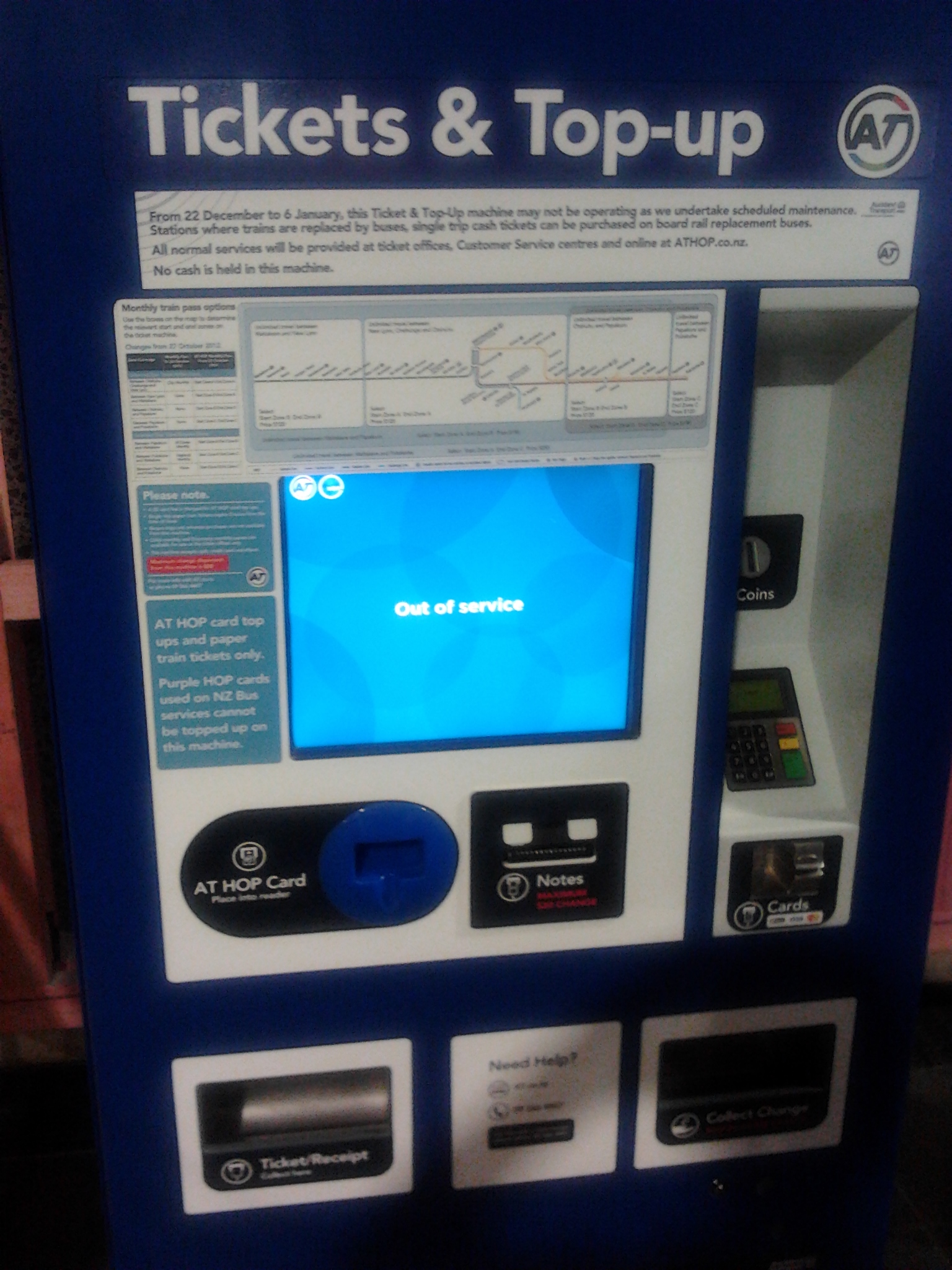
Yes the sole machine was out of order, however tech support had been notified 10mins earlier

Well I managed to personally stave off a fare rise for AT-HOP care users in September last year (Fare Increase Ctd) for rail users. However, this time no such luck – you are going to be lugged with it this time around.

From the NZ Herald this morning after AT announced it last yesterday

Students bear the brunt of Auckland public transport fare rises

Auckland Transport has been accused of targeting students with public transport fare rises that will also affect thousands of Hop and multi-trip ticket buyers.

Auckland Transport – which waited until late yesterday to announce changes approved by its board two months ago – will lift cash fares for tertiary students by between 7c and 40c a trip on June 3.

Adults who use Hop cards on trains or 10-trip tickets on buses also face fare rises of 2c to 22c a ride.

Ten-trip tickets on inner harbour ferry trips such as from Devonport, Bayswater and Birkenhead to the city will also rise by up to $2, but water transport will become considerably cheaper for Hop card users.

A single trip fare for a Hop card user from Devonport to the city will fall from $5.40c to $4.10c compared with an unchanged cash price of $6, but ten-trip tickets will rise to $41.

That is to align Hop cards with multi-trip tickets, which Auckland Transport ultimately wants to scrap in favour of seamless travel across ferries, trains and buses.

Public transport operations manager Mark Lambert said close to 50,000 public transport users could be affected. The changes were required before Hop cards were rolled out to the city’s buses between June 23 and November, he said.

Auckland Council transport chairman Mike Lee asked why fares could not be aligned downward, particularly on trains.

“It seems the most loyal passengers are being targeted – students and those taking multiple trips.”

Auckland had the highest public transport fares of any Australasian city and students were “a key part of our market”, he said.

Mr Lambert said an increase in the student discount from 20 per cent to 40 per cent in 2008 proved highly effective in lifting demand and getting cars off the road, but there was a limit to ratepayer subsidies.

Auckland University Students’ Association president Daniel Haines said the fare rises appeared aimed at those who could least afford to pre-load Hop cards for multiple trips.

He said transport was the second highest cost facing students, after accommodation, and the increases would hit those who faced long trips from suburbs offering lower rents.
• For detailed information about fare changes, visit maxx.co.nz.

I remember fighting tooth and nail to retain the existing fares seen here below rather than having AT-HOP users pay a technical rise as AT were to flat line the discount rates at 10% right across the board

Savings with AT HOP

Adult Child/Accessible Tertiary
Cash fare HOP fare You Save! Cash fare HOP fare You Save! Cash fare HOP fare You Save!
1 stage $1.90 $1.60 16% $1.10 $0.90 18% $1.90 $1.10 42%
2 stage $3.40 $3.00 12% $2.00 $1.70 15% $3.40 $2.10 38%
3 stage $4.50 $4.05 10% $2.60 $2.29 12% $4.50 $2.79 38%
4 stage $5.60 $5.04 10% $3.40 $3.00 12% $5.60 $3.47 38%
5 stage $6.80 $6.00 12% $4.00 $3.55 11% $6.80 $4.21 38%
6 stage $7.90 $6.90 13% $4.50 $4.05 10% $7.90 $4.75 40%
7 stage $9.00 $8.00 11% $5.30 $4.75 10% $9.00 $5.58 38%
8 stage $10.30 $9.05 12% $6.10 $5.44 11% $10.30 $6.38 38%


I believe the new fare guide is not out but reading the material from AT properly you have:

  • Cash fares remaining the same
  • AT-HOP card fares going up as the percentage discount level is lowered across most if not all areas.

So rather than targeting the cash users and hiking the cash fares (if the actual fares did need to go up in the first place) which would move people over to AT-HOP, Auckland Transport go and hit “the little guy” who is already on AT-HOP. Ouch and nasty!

The AT-HOP fare rise also seems to be the exact opposite of the Deloitte HOP review would suggest


One wonders what the thinking was behind the latest move?


Simplifying the Rules?

What Does Section 4 of the Unitary Plan Mean?


Section Four of the Unitary Plan is arguably the most important part of the entire Unitary Plan. Section Four contains all the RULES and definitions of those rules that are seen in the Unitary Plan – and also does one’s head in on the way out. One has to remember that the Unitary Plan is a document based on our Resource Management Act 1991 and subsequent amendments as they come from Wellington. What activities are permitted, controlled, restricted discretionary, discretionary, non complying and prohibited are all spelt out in the Unitary Plan and the definitions provided in the RMA.

Unfortunately the RMA is a cumbersome document (I have a copy here at home) and could be easily one of three (what I call) pieces of super legislation New Zealand have. By super legislation I mean it is beyond thick as a brick in size, has language that would baffle most people and has the greatest effect on most ordinary citizens’ lives. Of course the other two pieces of super legislation that we all love to have would be Tax Law and ACC 😛

With a cumbersome document like the RMA comes an equally as cumbersome document we know as the Unitary Plan. At what ever pages thick and language that will leave 99% of the city befuddled (paraphrasing Orakei Local Board Chair Desley Simpson) you can see why residents and business might get upset with the Unitary Plan.


Where am I going with this?

Recently there was a major outcry on Mixed Housing Zones and what was entailed with them. In short as it has always been with a MHZ you can build a two storey (eight metre) house as of right – it is a permitted activity under most existing plans and the upcoming Unitary Plan. Where things get interesting is that you can build a three storey (10 metre) high house (not quite sure you can do Walk Up apartments though) providing you meeting the resource consent and urban design controls in place. This is because such an activity is classified as a Discretionary Restricted Activity per the RMA. Again this piece was already in most existing plans and is again in the upcoming Unitary Plan. So nothing different per se.

I believe what might have people “interested” is what does Restricted Discretionary Activity mean? In the Unitary Plan and as set out in the RMA it means:
4.1.4.3 Restricted discretionary activities

Resource consent is required for a restricted discretionary activity. Council may approve or decline a proposal for a restricted discretionary activity. The Unitary Plan specifies the matters over which council has restricted its discretion. Council’s consideration of the proposal, and the ability to refuse the application and impose conditions, is restricted to these matters.
The Unitary Plan uses this approach where it is possible to limit discretion to specific effects associated with an activity or development, which need to be assessed.

A permitted activity as a comparison is:

4.1.4.1 Permitted activities
Resource consent is not required for a permitted activity if it complies with all the relevant rules in the Unitary Plan. The Unitary Plan uses this approach to provide for activities to be carried out as of right, provided certain controls are met. If an activity does not comply with one or more of the relevant controls it is not a permitted activity. In those instances the activity will fall into one of the activity categories below and will require resource consent.
Existing uses
The RMA permits certain existing land uses, which were lawfully established, to continue despite contravening a rule in the Unitary Plan. These activities have existing use rights, but must satisfy the provisions outlined in s. 10 and s. 20A of the RMA.
It is the responsibility of the person claiming existing use rights to demonstrate they comply with the relevant sections of the RMA.
Certificates of Compliance (CoC)
An application can be made to council to obtain a CoC for a permitted activity. A CoC certifies that the development is fully complying. Section 139 of the RMA outlines the role of consenting authorities and environmental protection agencies in issuing CoCs. A CoC is treated as if it was a resource consent.

To provide the relevant Section Four material and what activities are what to the five residential zones I have these embeds

4.1 General Provisions

4.3.1 Residential Zones

And the Mixed Housing Zone document which all the Councillors and Local Board members have sitting in their email boxes but have not publicly released to their communities. The document is a public document and meant to be discussed with residents and businesses


Now from here a two prong situation arises.

First is that I do not like Restricted Discretionary Activities as it gives a central planner too much power away from the community. Yes we have to weigh up private property rights of the individual but for activities to be lugged under the RDA class means there is going to be more than a minor impact and those in the immediate vicinity might want to be notified. You know – a no surprises policy. The Centralised Master Community Plan and Semi-Liberal Plan District methodologies I am working on would restore a more community based approach to planning and assist a no surprises policy.

Second Prong is that the language in Section Four is a total dog and will do anyone’s head in. It even does my head in and I am supposedly clued up with planning, the RMA and the Unitary Plan. If the “planners” language is confusing people on what can actually happen in a Mixed Housing Zone then I don’t blame them for their confusion.

While this might need a rewrite of the RMA itself, maybe Council could to simplify the language their end and run a traffic light system for the class of activities followed by basic plain English of each of the lights/categories. Example:

  • Green: Permitted Activities
  • Yellow: Controlled Activities (usually activities that produce emissions or other pollutants that can be controlled); and Restricted Discretionary Activities (more relevant to residential zones and their subsequent activities)
  • Orange: Discretionary Activities
  • Red: Non Complying Activities

No need to mention Prohibited Activities as that is usually controlled by Central Government and often refers to things either toxic or nuclear in nature.

With a traffic light set up followed by basic plain English definitions if someone was to engage on an activity within one of the five residential zones; the citizen in question might have an easier time understand the rules and not be so confused.

I might work on simplifying and setting up a Traffic Light kind of system for the Unitary Plan but, not until after my submission is handed in by May 31.

In saying that; a well-informed citizen equipped with the knowledge and an understandable plan is a happy citizen. The opposite is a confused and angry citizen.

Maybe Council needs to work on its English in the Unitary Plan a bit better. Oh and lots of pictures – for pictures speak a thousand words (and save paper 😛 )


TALKING AUCKLAND

Talking Auckland: Blog of TotaRim Consultancy Limited

TotaRim Consultancy
Bringing Well Managed Progress to Auckland and The Unitary Plan

Auckland: 2013 – YOUR CITY, YOUR CALL


2040 Has an Alternative

Thoughts and Comments?


2040 Auckland and the Character Coalition have released a statement and letter on their alternative for the Unitary Plan. Please not I am not endorsing or disagreeing (yet), just seeking YOUR thoughts on what they have to say.

From 2040 Auckland and the Character Coalition

Auckland Mayor Len Brown and Deputy Mayor Penny Hulse meet Auckland 2040 Group for

Urgent Talks about Unitary Plan


Auckland 23 May 2013


In response to mounting public outrage following Auckland 2040’s disclosure of the implications behind critical elements of the draft unitary plan, Auckland 2040 Founders Richard Burton and Guy Haddleton met this week with the Mayor, and Deputy Mayor for intensive discussions.


The meeting was constructive, with the Mayor willing to consider proposals put forward by Auckland 2040 for amendments to the plan. He also expressed a commitment to have a fair and meaningful dialogue with Auckland 2040 over the next few months, stating that the Unitary Plan would not be notified in September until 80-90% of the issues were resolved.


Following the meeting, Auckland 2040 has submitted their proposals in a letter to the Mayor and is now awaiting feedback.


Comments Richard Burton, “I look forward to the healthy public debate that will emerge from our proposal and our participation in on-going discussions with Council”


Letter to Auckland Mayor below:


22 May 2013


His Worship the Mayor


Our thanks to you and Deputy Major Ms P Hulse for taking the time to meet with Auckland 2040 and the Character Coalition yesterday. We were very pleased to read in the NZ Herald that you agreed with much of what we said.


A fundamental issue in looking at the future growth of Auckland is the extent to which Auckland is likely to grow over the next 30 years. That Auckland is growing and will continue to grow is undisputed; it is the rate and extent of growth which is at issue. Significant under or over estimation can have profound effects on future planning. We request that Auckland City:


  • Be completely transparent in revealing the statistical justification for Council’s 1,000,000 population increase forecast for the next 30 years


  • Reconsider the Auckland population estimate of 1,000, 000 additional population over the next 30 years to align with Statistics NZ Medium estimates. Overseas cities generally adopt the Medium estimate in planning for growth and then monitor that estimate over time, with adjustments up or down depending on actual growth. The High estimate as used by Auckland Council may overstate actual growth by as much as 50%. Overstating the population increase has serious implications on infrastructure and the need for high density intensification and or greenfields development.


The Draft Unitary Plan has been prepared on the basis of an additional 1,000,000 population over 30 years. Even if Auckland reaches such growth levels, it will not happen overnight but rather in a progressive incremental manner. It is thus logical to release land for intensification and green field’s development in a staged manner. To zone immediately 56% of Auckland’s residential areas for unrestrained, scattered apartment development is neither logical nor staged. Neither would immediate release of greenfields land sufficient for 400,000 people be logical or staged. Fortunately no-one is suggesting the latter.


We are not opposed to intensification, nor apartment development. We are opposed to scattered, un-planned, uncoordinated developments with no or inadequate consideration of urban character values, heritage values or infrastructure and no community consultation.


Certainty in an urban framework context is of fundamental importance to most people living in or buying into neighbourhoods. While alteration or addition of dwellings is largely accepted, structures introducing a different, more discordant building form are strongly opposed. Many residential areas have a mature character with established dwellings and streetscapes. Some have a dominant heritage character. Many of the most popular areas have had significant infill, but the infill is of a similar character to the existing housing so is accepted, albeit reluctantly in some quarters. Apartment buildings are a very alien building form in those streetscapes and the uncertainty of whether this form of development will occur in “my street” is what is galvanizing Aucklanders to object to Council’s proposals.


Auckland 2040 and the Character Coalition request that Council approach the Unitary Plan in a more planned and staged manner. Specifically Council should reduce the amount of land zoned for apartment development and instead have a more targeted focus providing development opportunities while preserving most of the existing residential areas.


If demand indicates more apartment zoned land is required, Council can undertake the appropriate neighbourhood or town centre studies with meaningful community involvement prior to release of more land for redevelopment. If full structure planning is required prior to release of greenfields land then why should not the same apply to intensification proposals within the existing urban area?


The following proposals should be considered in the context of the above statements. We request the Auckland Council give consideration to the following proposed amendments to the Unitary Plan:


  1. The introduction of a new residential Infill Zone which allows one and two storey buildings only and permits infill at a density of one unit per 350m2 net site area. This zone to be applied to the majority of the residential areas and in particular to residential areas which:
    1. Retain a strong residential character of 1 –2 story dwellings ,or
    2. Have significant heritage values, or
    3. Are close to sensitive environments such as the coast, lakes, volcanic cones, or
    4. Have been subject to considerable infill development, but which retain predominantly stand-alone housing, or
    5. Have topographical challenges which would tend to increase the adverse effects of apartment buildings


  1. The Mixed Housing Zone be restricted to areas in close proximity to town centers or selected arterial routes with good roading, public transport and infrastructure and which do not have the characteristics in (1) above.


  1. The Terrace House and Apartment Zone be confined to areas immediately adjoining inner city or Metropolitan Centres, plus the major town centres subject to (5) below.


  1. Development controls to be reconfigured to address adjoining property effects, and height limits to be restricted by full discretionary activity status, including public notification and affected party’s consents for exceeding height.


  1. That Metropolitan, Town Centre and neighbourhood studies be undertaken with community involvement to determine the most appropriate zoning mix after due consideration of existing urban character, heritage values, infrastructure and traffic. That Council reconsider town centre studies undertaken by previous council’s or Environment Court decisions affecting specific areas and incorporate the principal findings of those studies/decisions into the Unitary Plan.


  1. That should Council determine that additional intensification is warranted in the future due to increased demand, Council undertake structure planning of the areas where intensification is planned. Such structure planning should be similar in scope to that required for greenfields planning and have an aim of achieving a significant degree of community consensus.


We would welcome the opportunity to discuss these proposals in a constructive manner with Council and senior staff.


Yours sincerely,


Guy Haddleton, Auckland 2040

Richard Burton, Auckland 2040

Sally Hughes, Character Coalition


About Auckland 2040


Auckland 2040 is a newly formed grass roots organization of non political residents passionately concerned about the future planning and shape of Auckland. Its web site is www.auckland2040.org.nz


Comments and thoughts in the comment box below


Those Secret Papers are Back Again

Slow News Day?


I see Orsman is banging on about secret papers again with the Unitary Plan:

Mayor to decide release of secret housing zone papers

By Bernard Orsman


Auckland Mayor Len Brown is sitting on secret documents about controversial plans which would make up to three-storey apartments possible in half of residential Auckland.

The Herald asked Mr Brown on Tuesday to release documents used to draw up the mixed housing and terraced housing and apartment zones in the new planning rulebook, or Unitary Plan.

The request was made under the emergency provisions of the Local Government Official Information and Meetings Act so they could be made public before feedback on the draft plan closes on May 31. Last night, a spokesman for Mr Brown said the mayor’s office was working through the request and would provide a response shortly.

The documents were the basis for a political working party to develop heights and controls for the two zones that have a profound effect on more than half of residential Auckland. The working party, which meets behind closed doors, makes recommendations to the Auckland Plan committee which discusses issues in public.

A member of the political working party said officers provided no in-depth analysis on the two zones and had belatedly revealed the three-storey height limit in the mixed housing zone.


I was sure I have covered this before so I went for a look and found this:

THOSE SECRET PAPERS

Posted by BR:AKL_Admin01 on April 30, 2013 · Leave a Comment(Edit)

Where’s Wally?


You can go read the piece by clicking the respective hyperlink.


After digging that post up I went digging through the emails again as I remember a conversation about those papers. Yep the emails are still there from April 29. The emails gave rise to my particular post on April 30 and seem to give rise to this post today.


Now this presents an interesting situation which has two possible paths:

  1. There is more to those papers than I got led to believe on April 29. This means the mayor and deputy mayor might need to come clean here if this the case. While I have respect for the Deputy Mayor that respect can be lost fast if I was led to believe one thing when the opposite occurred. Trust and confidence applies here
  2. Orsman is full of crap again and rehashing a month old story. While that would be nothing particularly new I noted this remark “A member of the political working party said officers provided no in-depth analysis on the two zones and had belatedly revealed the three-storey height limit in the mixed housing zone” to which I can think of two Councillors who might say that. If that is the case then a leak perhaps to substantiate the claim. Otherwise the city is running around like headless chickens (cue the Julia Gillard headless chook experiment video which actually you should watch. Just replace Gillard with Len Brown and you should get the rest) to which Kevin Rudd‘s quip: “Everyone should take a very LONG cold shower” could very well apply to the Unitary Plan as it stands.


So what path we will all go down is now on apparently what the mayor is meant to release “shortly.”


The city waits


The Karaka Collective Presentation

Musings on the presentation


I have been meaning to get this piece up onto the blog for a while about the Karaka Collective presentation recently. I have not got the Physical Powerpoint presentation on me but, will chase it down from the Collective and upload it to the blog ASAP.


On May 13 at Karaka Hall, Peter Fuller representing the Karaka Collective gave a presentation of the Collective’s “submission” and vision for Karaka West and Karaka North. This also included the Weymouth-Karaka Bridge which seems to be causing enough upset from both sides of the harbour.

I have been asked for comments on the meeting as I was there. These are my thoughts and some responses to queries I got asked which covered both the physical presentation and the subject matter at hand:


The meeting in itself was civil and hats off to residents knowing the issue is both passionate and a sore issue (for both Karaka and Weymouth).
For the presentation it was too long and should have only be at maximum 10 minutes for the matter presented. Anything beyond a 20 minute mark in presentations and you lose the audience. I nodded off at the 20 minute mark to which I decided to go over and start talking to Councillors Fletcher and Penrose on the matter at hand.

I would have recommended to follow what is called a split presentation when giving a talk on material that can be quite heavy or quite extensive.

The split presentation format I used for the Auckland Plan Committee last week in my Manukau Presentation ( https://voakl.net/2013/05/15/the-manukau-presentation/ ) had both a short power point presentation covering the main points and a “booklet” with all the information at hand.

Both the presentation and the booklet is sent to the committee in advance for advanced reading leaving me to go over briefly the main points of my argument. The committee with the booklet in hand then asks questions they might have. It was a useful technique and allowed maximum time for the main purpose; questions or what I like to call dialogue if executed properly.

Peter Fuller should have split the presentation with both a short 10 minute brief covering the main points, followed by a booklet with all the finer details for further reading – and had it released a week in advance. Bloggers like myself would have picked up on this and both republished the information and ran commentary on it.

Although in saying that there is a risk of preempting the Collective’s presentation of information and allowing the residents to form questions before hand. Or allow bloggers like myself to take control of a debate and frame the argument. Risks but risks the Collective will have to take if they want their plan to progress. Also something a particular Herald journalist and elected representatives on the North Shore find out too when they get debunked for utter misrepresentation of information. So the remedy is simple; tell the truth from the beginning and you have nothing to fear. Tell a porker and don’t expect much forgiveness from people nor bloggers in return. The Collective were being honest and their ambitions known.

While the material in Fuller’s presentation was too long and too heavy with the presentation too full of planning and officialdom jargon. It could also be taken that the information presented in a way that was talking down to everyone in the room. So a patronising effect that will chill residents and elected representatives

As for the questions they were pretty good, as for the answers they were not. Fuller was okay with the answering but the other two that were land owners I had real issue with. Their answers were put in a way of both putting down the room and issuing a challenge to the room to “meet them” in the Environment Court which is likely where this issue will end up. I have taken note from Brigid her comment which was (it is public):

“I was at that meeting and there seemed to be a difference between how Bruce Wallace envisioned a Weymouth-Karaka link and what Peter Fuller showed in his presentation. Bruce Wallace seemed to be wanting de facto motorway that would get him quicker to and from the airport and lower congestion on SH1 so he could get to work in under 20mins. However Don McKenzie the traffic expert on the Collective team said any Weymouth-Karaka link would not lessen congestion. And Peter Fuller spoke of a 60-80k Te Irirangi Drive/Te Rakau Drive equivalent. ”


This folks is what you call an effective “Buggers Muddle” – that is a pile of different answers that basically contradict each other to the point oxymoron becomes the norm. Three different answers that would have three very different consequences on that particular bridge. Not entirely confidence material nor helpful for both Auckland Transport and NZTA if they ever decided to run with the project. So lets look at the points individually:


  • Bruce Wallace seemed to be wanting de facto motorway that would get him quicker to and from the airport and lower congestion on SH1 so he could get to work in under 20mins.

Umm no and won’t happen. Auckland Transport and NZTA would have to overcome hell and high water from Southern Auckland to get a de-facto motorway put in and the bridge built. The Benefit Cost Ratio would be below 1.0 owing to the massive environment (physical and social) consequences (mainly negative) to the entire area of the de-facto motorway proposal. The “motorway” would not lower the congestion on State Highway One especially when the Greenfield areas get built up. The only way to bet congestion on State Highway One is to 6-lane the motorway all the way to Drury interchange, get the rail service more effective and efficient, and development some large employment centres close to home (Manukau, Wiri and Drury). If one wants a quick trip to the airport then may I suggest throwing your support and money behind the Airport Line from Manukau Station to the airport. Coupled with the EMU’s you could be there in well 30 minutes without the traffic crap on the roads…


  • However Don McKenzie the traffic expert on the Collective team said any Weymouth-Karaka link would not lessen congestion.

Excuse the language but No Crap Sherlock. It will not lessen congestion any where. All that bridge will do is cause rat running through an established community causing misery and literal hell. Yes I see Weymouth has the strip to allow a 4-lane road but it is now too late for the road. That road and bridge should of been built 50 years ago to 4-lane specifications before Weymouth took firm settlement. The settlement could of then be built around the road and bridge rather than the community now being built around the road. As I said the only way to lessen congestion is what I mentioned above. Through in a proper Regional Public Transport Plan and I would say you could remove all together 33% of the cars off the road at a minimum while still allowing transit choice


  • And Peter Fuller spoke of a 60-80k Te Irirangi Drive/Te Rakau Drive equivalent. “

So an expressway option. Last I looked that the communities around Te Irirangi Drive were built in a way that they were mitigated from the most serious aspects of that road. That is the road was built around the community with green shelter belts and lane ways to access the houses (that is no house has a direct driveway access to Te Irirgani Drive in the new sections of that road). The older sections at the Manukau end of the road and along Te Rakau Drive which do have direct driveway access to the road show the implications of planning not done properly. What we see in the older sections of Te Irirangi Drive with direct driveway access rather than green belts and lane ways off the road is what we would get in Weymouth. Not fun for the residents nor particular safe for an 80km expressway either… It is of note that the Manukau end of Te Irirangi is at 60km/h while the new Botany sections are at 80km/h. That 80km/h section has the greenbelt and lane ways shielding the houses from the road. I wonder if the Collective would be willing to stump the cash up to retrofit Weymouth Road with those lane way shields if they want their bridge built. Probably not, so I wouldn’t want a 80km/h expressway either without the proper mitigation in position FIRST.

In regards to Bruce Wallace (seem to remember him rather well for some odd reason), I don’t particularly care if one has had issues with the old Councils. Most of us would have had crap from the legacy Councils so we know what it is like (Manukau Station being a pet peeve for me with the old Manukau City Council that I am still trying to fix up with the current Council). But what I do care is them short circuiting the RUB process and apparently trying to buy their way into outcomes favouring them via the Unitary Plan.

I did ask the final question for the night regards to the Collective supporting existing and new infrastructure projects before backing the Weymouth Bridge. Those projects include Glenora Road Station, Spartan Road Station, the Manukau Rail South Link, the RPTP with the bus routes and so on. While they said they would and might have done so (meaning I need to dig up submissions), I highly doubt it unless they prove me wrong over the next 7 years.
In saying that I am working on my submission to stave off that bridge as long as possible through a formation of a new regional park on the Karaka side. This has been mentioned before in this blog before

The submission will go up on my blog as soon as its finished.

Otherwise the meeting was handled well by the residents from a group short circuiting the processes the rest of us have to go through via claiming it is for the good of Auckland.


Those were my thoughts in the presentation. As I point out to the Collective, those ARE MY THOUGHTS AND INTERPRETATIONS of that presentation. If the Collective differs to my interpretations they are free to share a guest post – that is less than 2500 words and in plain English. Graphics help and can be facilitated easy into the blog.


In the mean time people do not forget your submission to the Unitary Plan in before May 31 – 5pm